Rio de Janeiro is one of those rare cities whose clichés are mostly accurate. The mountains really do rise dramatically behind the beaches, football is everywhere, samba remains part of the city’s identity and the view from Corcovado really does look as though somebody designed the landscape specifically to sell airline tickets. What the postcards leave out is how varied Rio feels on the ground: beaches, tropical forest, granite peaks, historic neighbourhoods, modern museums and nightlife districts are scattered around Guanabara Bay and separated by hills that have shaped the city almost as much as its inhabitants.
This is not a compact historic capital where every major attraction sits within a pleasant twenty-minute walk. Copacabana feels different from Ipanema, Santa Teresa bears little resemblance to Centro, and the dense urban fabric can suddenly disappear into Atlantic Forest. The famous landmarks deserve their fame, but the best way to experience Rio is to combine them with neighbourhoods, samba, football, botecos and enough unscheduled time to watch carioca life happen around you.
Cristo Redentor and Corcovado
No first visit to Rio really avoids Cristo Redentor, nor should it. The Art Deco statue stands on the summit of Corcovado, more than 700 metres above the city inside Tijuca National Park, and its setting matters at least as much as the monument itself. From the top, Rio’s complicated geography suddenly becomes intelligible: Sugarloaf rises beside Guanabara Bay, Lagoa Rodrigo de Freitas sits beneath the mountains, the beaches trace the Atlantic coast and neighbourhoods occupy almost every piece of level ground left between rock and water.
The traditional approach is the Corcovado train from Cosme Velho, which climbs through the forest, although authorized vans also provide access. Check the weather before going because cloud and low visibility can erase most of what you came to see, leaving Christ magnificently presiding over a large quantity of grey. Crowds are unavoidable, particularly around the viewing platforms, so arriving earlier in the day generally makes the experience less competitive.
Sugarloaf Mountain and Urca
If Corcovado gives you the classic aerial overview, Pão de Açúcar — Sugarloaf Mountain — arguably gives you the prettier panorama. The cable-car journey begins at Praia Vermelha in Urca, first climbing to Morro da Urca and then crossing to Sugarloaf itself. From the upper viewpoints, Guanabara Bay, Botafogo, Flamengo and the Atlantic spread out below, with Cristo Redentor visible across the city in the opposite direction.
Late afternoon is particularly rewarding, when the changing light works its way across the bay and the city begins to illuminate below. If you want to add some exercise without turning the visit into an expedition, walk along the Pista Cláudio Coutinho, where a relatively short trail leads toward Morro da Urca; from there you can continue using the cable car. Rio has thoughtfully arranged the mountain so both hikers and people who consider cable cars an important technological achievement can enjoy it.
Copacabana
Copacabana may not be Rio’s most beautiful beach, but it remains its most famous urban stage. The broad curve of sand, the black-and-white wave-pattern promenade and the wall of buildings behind Avenida Atlântica form one of the world’s most recognizable cityscapes. More importantly, the beach is actively used: football, footvolley, running, swimming, vendors, kiosks and groups drinking coconut water or beer make the waterfront feel like an extension of the neighbourhood rather than a resort separated from it.
Even if you have no intention of lying on the sand for hours, walk a good section of the promenade and spend some time observing how the beach works. Copacabana changes noticeably after dark as kiosks, restaurants, bars and more adult-oriented nightlife become increasingly visible, but those deserve their own guides rather than being shoehorned into a beach description. One practical rule is worth carrying everywhere: take only what you actually need to the sand, because Rio provides enough memories without donating your phone to the local secondary economy.
Ipanema, Leblon and Arpoador
West of Copacabana, Ipanema feels more polished and somewhat less theatrical. Its beach is divided informally by the postos, or lifeguard posts, which attract different crowds, while the blocks behind the seafront contain restaurants, bars, cafés and shops. Continue toward Leblon and the atmosphere becomes wealthier and more residential; neither neighbourhood requires an exhausting checklist because much of their appeal lies simply in walking the streets and spending time near the beach.
Between Ipanema and Copacabana, the rocky headland at Arpoador provides one of Rio’s classic sunset views. When conditions cooperate, crowds gather on the rocks as the sun disappears behind Morro Dois Irmãos, and spontaneous applause is not unusual. Reacting enthusiastically to the predictable movement of a star 150 million kilometres away may sound excessive, but the scenery makes a fairly convincing defence.
Lagoa Rodrigo de Freitas
Behind Ipanema and Leblon lies Lagoa Rodrigo de Freitas, surrounded by some of the city’s most striking mountain scenery and expensive residential neighbourhoods. A path circles the lagoon and is popular with cyclists, joggers and walkers, while Corcovado rises dramatically behind the water. It is one of the easiest places to appreciate how closely Rio’s landscape and urban fabric coexist without having to queue, buy a ticket or board anything suspended from a cable.
Lagoa also works well geographically with Jardim Botânico and Parque Lage, so the three can be combined into a slower half-day away from the major tourist sites. That is usually more efficient than crossing Rio repeatedly because somebody’s online itinerary grouped attractions by alphabetical order.
Tijuca National Park
Rio’s natural landscape does not begin at the edge of the city; it runs through it. Tijuca National Park protects a large area of Atlantic Forest encompassing mountains, waterfalls, viewpoints and hiking trails, with Corcovado itself forming part of the protected area. Much of the forest was restored during the nineteenth century after coffee cultivation and other development had severely damaged the original vegetation, making its present appearance as much a story of reforestation as untouched wilderness.
The Pico da Tijuca, at just over 1,000 metres, is the park’s highest summit, while Pedra Bonita offers a more accessible hike and a famous hang-gliding launch point overlooking São Conrado. Pedra da Gávea is considerably more demanding and should not be treated as a casual stroll because somebody on social media completed it wearing fashionable trainers. Easier alternatives include forest drives, waterfalls and viewpoints such as Vista Chinesa, which already provide a Rio very different from the beaches below.
Parque Lage and Jardim Botânico
At the base of the mountains, Parque Lage combines forest, landscaped grounds and an early twentieth-century mansion whose courtyard has become one of Rio’s most photographed architectural settings. Corcovado rises behind the building, creating one of those suspiciously well-composed views Rio produces without apparent effort. The park also provides access to trails, although conditions and routes should be checked before attempting anything substantial.
Nearby, the Jardim Botânico dates back to the early nineteenth century and contains an extensive collection of tropical and subtropical plants. The avenue of imperial palms provides the famous photograph, but there is enough botanical variety to justify spending proper time inside. Together with Lagoa, these two attractions are particularly useful when you need a day that does not involve fighting for a square metre on a viewing platform.
Santa Teresa
High above Centro and Lapa, Santa Teresa offers another version of Rio built around steep streets, historic houses, studios, small bars and hillside views rather than beachfront towers. The district has long had a bohemian reputation, and its old architecture and winding streets make it one of the most distinctive neighbourhoods in the city. The yellow Santa Teresa tram remains one of its symbols, crossing the former Carioca Aqueduct before climbing toward the hills.
Rather than trying to convert every building into an attraction, use Largo dos Guimarães and the surrounding streets as a loose centre and explore from there. Museums, galleries and viewpoints are scattered throughout the neighbourhood, and walking downhill toward Lapa creates an easy connection with the next part of the city. Doing the route in reverse is also possible, although Rio will then remind you why the word “hill” appears so frequently in descriptions of Santa Teresa.
Escadaria Selarón and Lapa
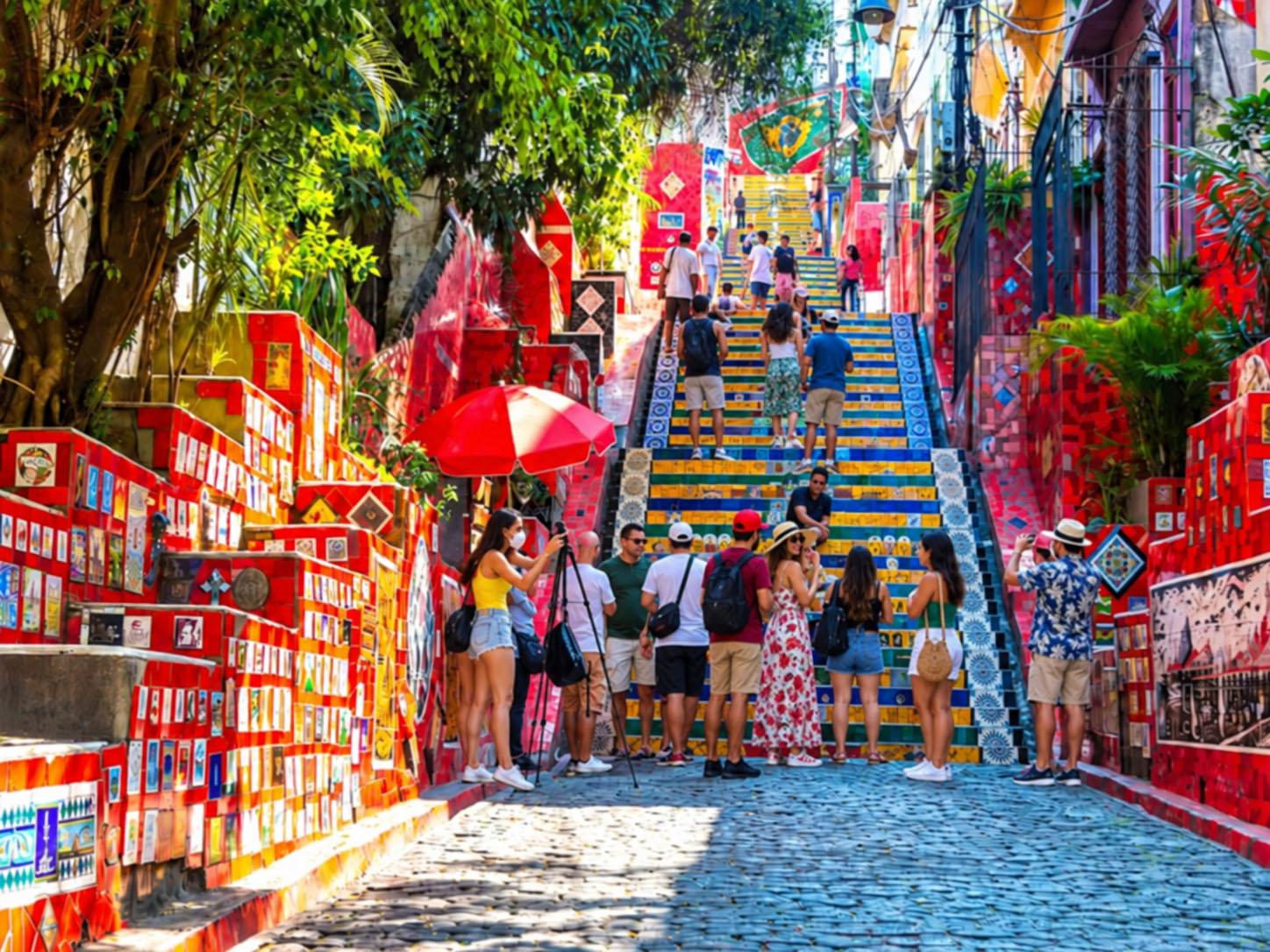
At the lower edge of Santa Teresa, Escadaria Selarón is one of those attractions that sounds slightly underwhelming when described as “a staircase covered in tiles” and works far better in person. Chilean artist Jorge Selarón spent years transforming its 250 steps with thousands of colourful tiles, including pieces sent to him from countries around the world. It became an evolving work of public art and eventually one of Rio’s most recognizable urban landmarks.
The staircase leads naturally into Lapa, where Rio’s historic architecture and nightlife overlap. The great white Arcos da Lapa were originally an eighteenth-century aqueduct carrying water into the city; today the Santa Teresa tram runs across the structure while streets below fill with bars, music venues and late-night crowds. Samba and live music remain major reasons to come here, but Lapa also hosts rock, electronic music, Brazilian funk and other styles. It deserves a separate nightlife article because individual venues change far more quickly than the neighbourhood’s importance.
Centro: The Historical City
Rio’s Centro is often overlooked by visitors staying near the beaches, partly because it still functions primarily as a working business district. During the day, however, it contains some of the city’s most important historic architecture, churches and cultural institutions, with colonial buildings appearing unexpectedly between modern office towers. The Candelária Church, Theatro Municipal and several major museums make the area worth exploring rather than treating it merely as somewhere the metro passes through.
One of Centro’s most memorable interiors is the Real Gabinete Português de Leitura, founded by Portuguese immigrants in the nineteenth century. Its neo-Manueline reading room is surrounded by shelves containing a vast collection of Portuguese-language books and manuscripts, creating a space impressive enough that nobody will ask whether you have actually read any of them. Centro is best explored during the day; once offices close, many streets become much quieter and less useful to a visitor looking for evening atmosphere.
Porto Maravilha and Museu do Amanhã
Rio’s former port district was radically transformed through the Porto Maravilha redevelopment, particularly around Praça Mauá and the waterfront. Public spaces, museums, street art and promenades replaced a landscape once dominated by port infrastructure and an elevated highway, creating one of the most visible changes associated with preparations for the 2016 Olympics.
The architectural centrepiece is the Museu do Amanhã, designed by Santiago Calatrava and devoted to science, technology, sustainability and possible futures for humanity rather than a conventional collection of historical objects. Nearby, the Olympic Boulevard and Eduardo Kobra’s enormous mural add to an area that now feels substantially different from the old commercial port. This is one of the clearer examples where an Olympic redevelopment produced something travellers might actually want to visit after the closing ceremony.
Maracanã and Football
You do not need to care deeply about football to understand why Maracanã matters. Opened for the 1950 World Cup, the stadium has hosted two World Cup finals, Olympic events and countless major Brazilian matches, while clubs such as Flamengo and Fluminense remain woven into the city’s identity. Even on ordinary days, shirts in red and black, green and maroon, black and white or Vasco’s diagonal sash provide a useful lesson in local loyalties.
A stadium tour is worthwhile if there is no suitable match during your visit, but experiencing Maracanã with a large crowd provides a much better explanation of Brazilian football culture than any collection of memorabilia. Fixtures and tour access can change around matches and events, so this is one attraction where checking the schedule beforehand is genuinely necessary rather than excessively organized travel behaviour.
Carnival, Samba and the Sambadrome
Rio’s Carnival is far more than the televised parade, although the samba-school competition inside the Sambódromo is certainly the most spectacular component. The schools spend much of the year preparing music, costumes, choreography and enormous floats for a competition that combines community tradition with industrial-scale logistics. If you attend, you are watching the result of months of work rather than a colourful street party improvised several hours earlier.
Outside the Sambadrome, hundreds of blocos fill neighbourhoods throughout the city, ranging from relatively local gatherings to massive events drawing enormous crowds. Rehearsals and pre-Carnival celebrations begin long before the official festival dates, so the samba calendar is considerably larger than four nights in February or March. Outside Carnival season, seek out genuine live samba and school rehearsals rather than tourist productions designed mainly to prove that Brazil owns sequins.
Eat and Drink Like You Are in Rio
Rio’s food deserves its own guide, but it would be strange to discuss things to do without mentioning eating. Feijoada, the famous black-bean and pork stew served with rice, greens and farofa, is the obvious heavyweight, while pão de queijo, coxinhas, empadas and pastéis are much easier commitments when you simply want something quick. Churrasco is ubiquitous, seafood benefits from the coastal setting and açaí appears everywhere in its sweet frozen carioca incarnation.
The boteco is equally important. Traditionally a simple neighbourhood bar serving beer, drinks and inexpensive snacks, the category now ranges from magnificently unpretentious establishments to carefully designed places that discovered the word boteco is excellent branding. Sooner or later there will also be a caipirinha: cachaça, lime, sugar and ice, a formula whose apparent simplicity has created a significant number of poor decisions worldwide.
Rio After Dark
Rio’s nightlife is distributed across several parts of the city rather than concentrated into one universal entertainment district. Lapa remains the obvious starting point for samba and live music, while Copacabana mixes bars, clubs, beach kiosks and more tourist-oriented venues. Botafogo has developed a strong bar and alternative nightlife scene, while Ipanema and Leblon provide more polished options closer to the beaches.
Samba, choro and bossa nova coexist with Brazilian funk, electronic music, rock and hip-hop, so asking for “the best nightlife area” without specifying what you want is not particularly useful. Rio has enough evening culture for a dedicated Rio de Janeiro Nightlife guide, where individual venues and neighbourhood differences can be treated properly rather than condensed into a list that will age before the next Carnival.
Other Things to See
Rio also has a substantial adult-entertainment sector that is relevant to the Lonely Punter audience. One characteristic local format is the terma, an adult club traditionally combining sauna or spa-style facilities, bars and private spaces, alongside more conventional clubs, massage venues and an extensive freelancer scene. Termas Monte Carlo, commonly known as TMC, in Copacabana, is one of the better-known names historically associated with this side of Rio and gives some indication that the city’s adult nightlife goes considerably beyond the stereotypical idea of freelancers around the beachfront. In general, it’s not hard to find female company in Brazil, and even less so in Rio de Janeiro. The dynamics are often pretty simple and spontaneous, but it’s always a good idea to keep your eyes open in certain contexts.
That is enough detail for a general guide. Which venues remain worthwhile, how the termas system works, current prices, safety, etiquette and the practical differences between Copacabana, Centro and other areas belong in a dedicated Rio de Janeiro After Dark article. As with Vienna and Frankfurt, the point here is not to turn the main city guide into an adult directory, but neither does Lonely Punter need to pretend that an established part of the destination does not exist.
A Note on Favela Visits
Rio’s favelas are residential communities rather than sightseeing attractions, and security conditions differ greatly between areas and can change quickly. Some communities have established local guides and cultural initiatives, but wandering into an unfamiliar favela independently because a map suggests a shortcut is not a sensible experiment. If visiting one genuinely interests you, use an established local operator and check conditions shortly beforehand.
The issue is not that every favela is permanently dangerous or inaccessible, nor that they should be treated as forbidden territory. It is that they are complex neighbourhoods where visitors generally have less local knowledge than they imagine, and Rio already offers enough spontaneous experiences without improvising one in an area whose security dynamics you do not understand.
How Long Do You Need in Rio?
Three full days are enough to cover postcard Rio if you organise them carefully: Cristo Redentor, Sugarloaf, the main beaches, Santa Teresa and Lapa, plus perhaps some time in Centro or Tijuca. It is possible, but the result can feel like an endurance event involving repeated negotiations with hills and traffic.
Four or five days is considerably better. That leaves room for Parque Lage and Jardim Botânico, Maracanã, Porto Maravilha, a proper evening out and enough time on the beach that your trip does not become a sequence of viewpoints interrupted by vehicle transfers. With longer, you can add Niterói, Barra da Tijuca, more substantial hikes or excursions elsewhere in Rio state.
One attraction that does not belong on an ordinary Rio itinerary is Iguaçu Falls. They are one of South America’s great natural sights, but they are not “near Rio” in any useful travel sense and deserve their own trip rather than appearing as item ten on a city sightseeing list. Brazil is a country roughly continental in scale, not a theme park whose major attractions occupy neighbouring car parks.
Rio de Janeiro: The Bottom Line
Rio works because the city and its landscape are almost impossible to separate. Cristo Redentor would not have the same impact without the mountains and bay below it, Copacabana would be just another urban beach without the hills framing the coast, and entire neighbourhoods seem to exist in negotiation with forest, rock and water. The big sights — Cristo, Sugarloaf, Copacabana and Ipanema — deserve their reputation, but they make considerably more sense once combined with Tijuca, Santa Teresa, Lapa, Centro, football, samba and a cold beer in a boteco.
Rio has spent decades being reduced to beaches, Carnival and attractive people wearing very little, none of which has exactly damaged its tourism prospects. They are simply fragments of a much larger city, and the more time you give it beyond the famous viewpoints, the more interesting it becomes.
