Frankfurt is one of those cities many travellers encounter before they ever decide to visit it. Its airport is one of Europe’s major hubs, its railway station connects half the continent, and its skyline appears regularly in stories about banks, interest rates and other subjects unlikely to inspire an immediate city break.
That reputation is rather unfair. Frankfurt has a compact historic centre, one of Germany’s strongest collections of museums, a genuine riverfront, several important sites in German political and literary history and a skyline unlike almost anywhere else in the country. Much of the old city was destroyed during the Second World War and later reconstructed, so Frankfurt does not offer the uninterrupted medieval fabric of some smaller German cities. What it does offer is a surprisingly effective mixture of reconstructed history, serious culture and unapologetically modern architecture.
You do not need to turn a visit into a military campaign against a checklist. These are the places most worth seeing.
Römerberg and the New Old Town
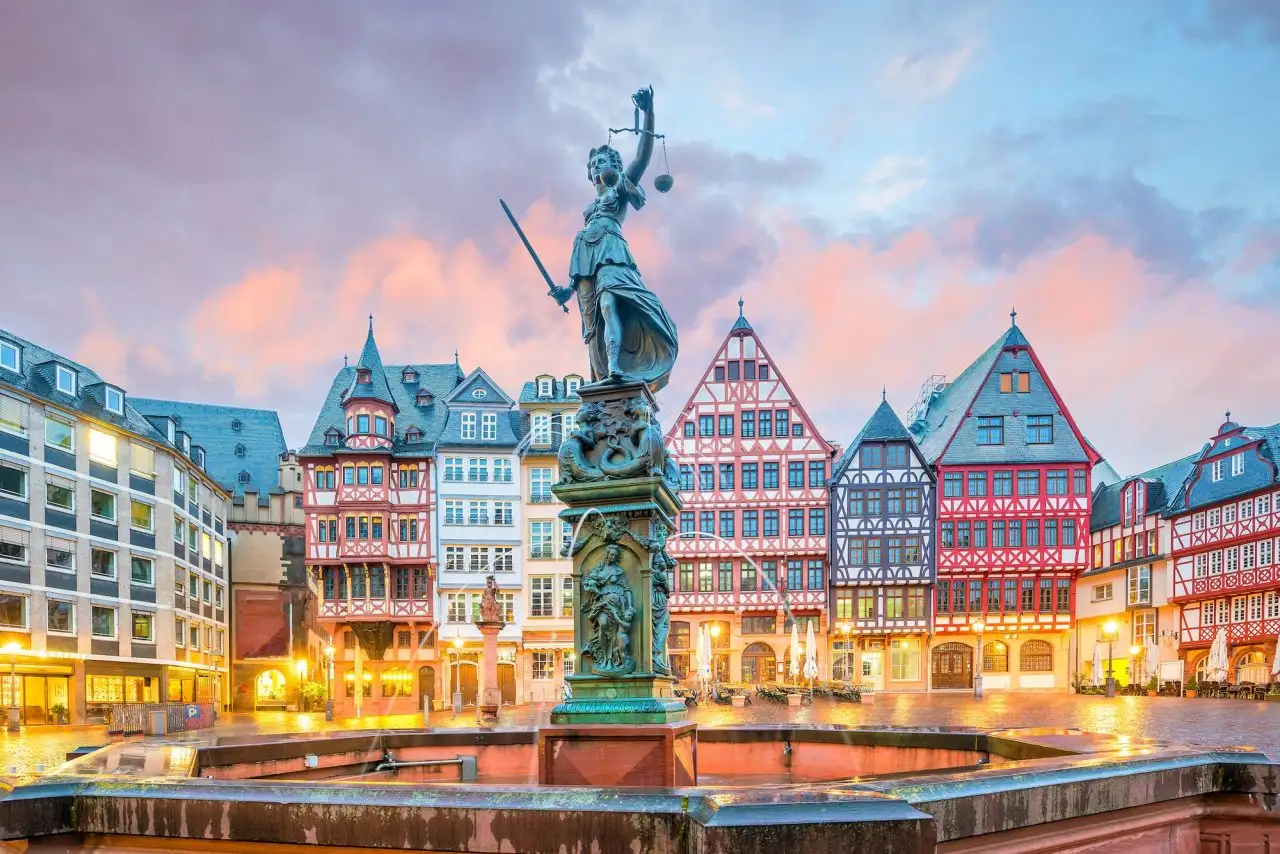
Start at Römerberg, the historic heart of Frankfurt and still the most obvious place to begin exploring the city. The square is dominated by the Römer, the distinctive town hall complex that has served the city for centuries, while the opposite side is lined by the reconstructed half-timbered houses of the Ostzeile. In the centre stands the Renaissance Fountain of Justice, watching over a square that has hosted markets, celebrations and major civic events for hundreds of years.
The important word here is reconstructed. Much of this part of Frankfurt was devastated by bombing during the Second World War, and the picturesque façades visible today are not all medieval survivors. The city has made no small effort to recover what was lost, culminating in the New Old Town between Römerberg and the cathedral. Completed in 2018, the project combines faithful reconstructions with new buildings inspired by the historic street plan.
Rather than taking the obligatory photograph of Römerberg and leaving, walk through the narrow streets toward the cathedral. Small squares, passages and reconstructed houses make this one of the most pleasant parts of central Frankfurt to explore on foot, and the compact size means you can see it properly without devoting half a day to the exercise.
Frankfurt Cathedral
At the eastern side of the old town stands St Bartholomew’s Cathedral, usually referred to simply as Frankfurt Cathedral or the Kaiserdom. Despite the name, it was never technically the seat of a bishop. Its importance comes instead from the Holy Roman Empire: German kings were elected here from the fourteenth century, and ten emperors were crowned in the church between 1562 and 1792.
The late-Gothic red sandstone tower rises to almost 95 metres and is one of the dominant landmarks of central Frankfurt. If the tower is open, 328 steps lead to a viewing platform above the old town. There is no elegant lift solution waiting halfway up, but the reward is an excellent view across Römerberg, St Paul’s Church and the modern financial district beyond.
The contrast is Frankfurt in one frame: reconstructed roofs and medieval church architecture in the foreground, banking towers behind them. Few German cities offer quite the same skyline without extensive Photoshop assistance.
St Paul’s Church
A short walk from Römerberg, St Paul’s Church is less visually dramatic than the cathedral but considerably more important politically. In 1848 it became the meeting place of the first freely elected all-German national assembly, whose delegates attempted to create a constitutional German state.
The revolution failed and the constitution they produced never came into force, but the Paulskirche Parliament became a major landmark in the development of German democracy. Today the building serves largely as a memorial and ceremonial venue rather than an ordinary church.
It is a quick visit and sits directly on the main old-town route, so there is little reason to skip it. Frankfurt may be better known for bankers than revolutionaries, but history occasionally has a sense of humour.
Kleinmarkthalle
A few streets north of Römerberg, Kleinmarkthalle is Frankfurt’s central covered market and one of the easiest places to see the city operating normally rather than performing for tourists.
Inside, dozens of stalls sell meat, fish, cheese, vegetables, bread, spices and prepared food, with German products sharing space with ingredients reflecting Frankfurt’s highly international population. It is a good stop around lunchtime, particularly if another formal attraction sounds less appealing than something edible.
Kleinmarkthalle deserves inclusion because it works both as a place to see and somewhere genuinely useful. You can browse for ten minutes, eat something, or linger considerably longer if German sausages are currently more interesting than German constitutional history.
Main Tower and the Skyline
Old Frankfurt is only half the picture. The other half goes vertically.
The financial district contains a concentration of high-rise buildings unusual enough in Germany to earn the predictable nickname Mainhattan. The best place to understand it is the Main Tower, a 200-metre skyscraper with a public viewing platform near the top.
From above, Frankfurt makes much more sense. The skyscrapers are packed into a relatively compact business district rather than spread across the entire city, while the Main cuts across the centre and the historic core appears almost miniature below. On a clear day the view stretches far beyond the urban area.
The outdoor platform is particularly good around late afternoon or toward sunset, although weather matters: strong winds or rain can close the exposed upper section. If the skyline is one of the reasons you came to Frankfurt, check conditions before heading up rather than discovering that clouds have thoughtfully removed the city for you.
Eiserner Steg and the Main
For a skyline view that costs nothing and requires substantially fewer metres of altitude, walk down to the Eiserner Steg.
The iron pedestrian bridge links the old town with Sachsenhausen on the southern bank of the Main. The first bridge was built in 1868, although the structure has since been rebuilt, and today it provides one of the classic views of Frankfurt: the cathedral and historic centre on one side, high-rises further west and the river running between them.
Its railings are covered with love locks, because apparently bridges throughout Europe are required by international treaty to carry several tonnes of romantic padlocks.
Crossing it is worthwhile for more practical reasons. The bridge connects Römerberg directly with the southern riverbank and the Museumsufer, allowing several of Frankfurt’s strongest attractions to fit naturally into the same walk.
Museumsufer and the Städel Museum
Frankfurt takes museums more seriously than its image as a business city might suggest. Along both banks of the Main, the Museumsufer brings together institutions dedicated to art, architecture, film, communication, sculpture and several other subjects.
If you only have time for one major museum, the Städel Museum is the obvious choice. Founded in 1815, its permanent collection covers more than 700 years of European art, from the Middle Ages through Old Masters and modernism to contemporary work. Rembrandt, Vermeer, Monet and Picasso are among the recognizable names, but the collection is substantial enough that celebrity spotting is a rather inefficient way to experience it.
Give the museum proper time. The Städel is not really suited to the sort of visit where you sprint past five centuries of European art because parking expires in forty minutes.
If art does not interest you, the Museumsufer still offers alternatives. The point is not to visit every museum along the river but to choose the one that actually appeals to you.
Goethe House
Johann Wolfgang von Goethe was born in Frankfurt in 1749, and his family home remains one of the city’s principal literary attractions.
The original building was destroyed during the Second World War and reconstructed after the conflict, incorporating surviving furniture, artworks and family possessions. The rooms recreate the prosperous eighteenth-century environment in which Goethe grew up and began writing.
The study is the highlight, associated with some of his earliest major work, including The Sorrows of Young Werther. The adjoining German Romantic Museum expands considerably on the literary context if Goethe is more than a name you vaguely remember from school.
For everyone else, the house is compact enough to remain interesting without requiring a postgraduate degree in German literature.
Senckenberg Natural History Museum
The Senckenberg Natural History Museum is one of those attractions frequently described as being good for children, which is an unnecessarily efficient way of discouraging adults from visiting an excellent natural-history museum.
The dinosaur hall is the immediate attraction, with large skeletons including Diplodocus, Tyrannosaurus and Triceratops, but the collections go far beyond dinosaurs. Fossils, mammals, marine life, biodiversity, evolution and material from the nearby Messel Pit form part of a museum that can easily occupy several hours.
If paintings leave you cold, Senckenberg is probably the best alternative to the Städel. There is no requirement to prove cultural sophistication by staring thoughtfully at an Old Master when you would rather look at a Tyrannosaurus rex.
Palmengarten
West of the centre, the Palmengarten provides a substantial change of pace after museums and city streets. The botanical garden covers around 22 hectares and combines landscaped outdoor areas with glasshouses containing plants from tropical, subtropical and temperate climates.
The greenhouses are what make it worth treating as a proper attraction rather than merely another urban park. You can move between completely different environments without leaving Frankfurt, which is particularly useful when German weather is demonstrating its less charming qualities.
The Palmengarten is open throughout the year, although opening hours vary seasonally. It is best approached as somewhere to wander rather than something to complete. If you find yourself calculating the minimum number of minutes required to “do” a botanical garden, you may as well go back to the pub.
Sachsenhausen
Cross the Eiserner Steg and you are in Sachsenhausen, one of Frankfurt’s most recognizable districts. The riverfront side contains many of the Museumsufer institutions, while further south the streets become smaller and more residential, with traditional taverns mixed among restaurants and bars.
Sachsenhausen is closely associated with Apfelwein, Frankfurt’s dry fermented apple drink, and remains one of the traditional places to try it. Food, drinking and nightlife deserve separate articles, however, so there is no need to turn this sightseeing guide into a catalogue of taverns.
For a first visit, the district works best as part of a walk: cross the river, explore part of the museum embankment, continue into the older streets and eventually circle back toward the centre.
Other Things to See
Frankfurt also has a side that conventional sightseeing guides tend either to ignore completely or reduce to a nervous sentence about the streets near the railway station. The Bahnhofsviertel, immediately east of the Hauptbahnhof, is one of the city’s most complicated central neighbourhoods, mixing international restaurants, hotels and bars with strip venues, brothels, the traditional red-light district and a highly visible drug scene. It is not representative of Frankfurt as a whole, but it is undeniably part of the city.
For Lonely Punter readers, there is another reason Frankfurt is considerably more interesting after dark. Frankfurt and the wider Rhine-Main region have a substantial FKK and sauna-club scene, with several established venues inside the city and numerous others in surrounding towns. This is not a marginal curiosity: the area is one of Germany’s better-known concentrations of large adult sauna clubs, and some visitors use Frankfurt specifically as a base for exploring them.
They belong on a list of things to see because, for the relevant traveller, they are exactly that. The individual clubs, formats, prices, etiquette, transport and practical differences between them are specialist territory, however, and will be covered separately in Frankfurt After Dark.
What to Prioritise If Time Is Short
If you only have a few hours, keep things compact. Start at Römerberg, walk through the New Old Town to the cathedral, pass St Paul’s Church, then continue to the Main and cross the Eiserner Steg. That route gives you the historic centre, the river and some of the best skyline views without wasting time moving across the city.
With half a day, add either Main Tower or one major museum. With a full day, the Städel, Goethe House, Senckenberg or Palmengarten can fill the remaining time depending on what interests you.
Berger Straße is pleasant for cafés, shops and neighbourhood atmosphere, but it is not essential on a first sightseeing visit. Likewise, there is no reason to travel across Frankfurt solely to tick currywurst off a German-food checklist. Food, nightlife, neighbourhoods and the adult side of the city all deserve their own guides rather than being awkwardly squeezed into this one.
Frankfurt may still be the place where you change planes, change trains or watch Europe’s financial system perform mysterious rituals. Give it a little time, though, and there is considerably more to see than the airport and a row of bank towers.
