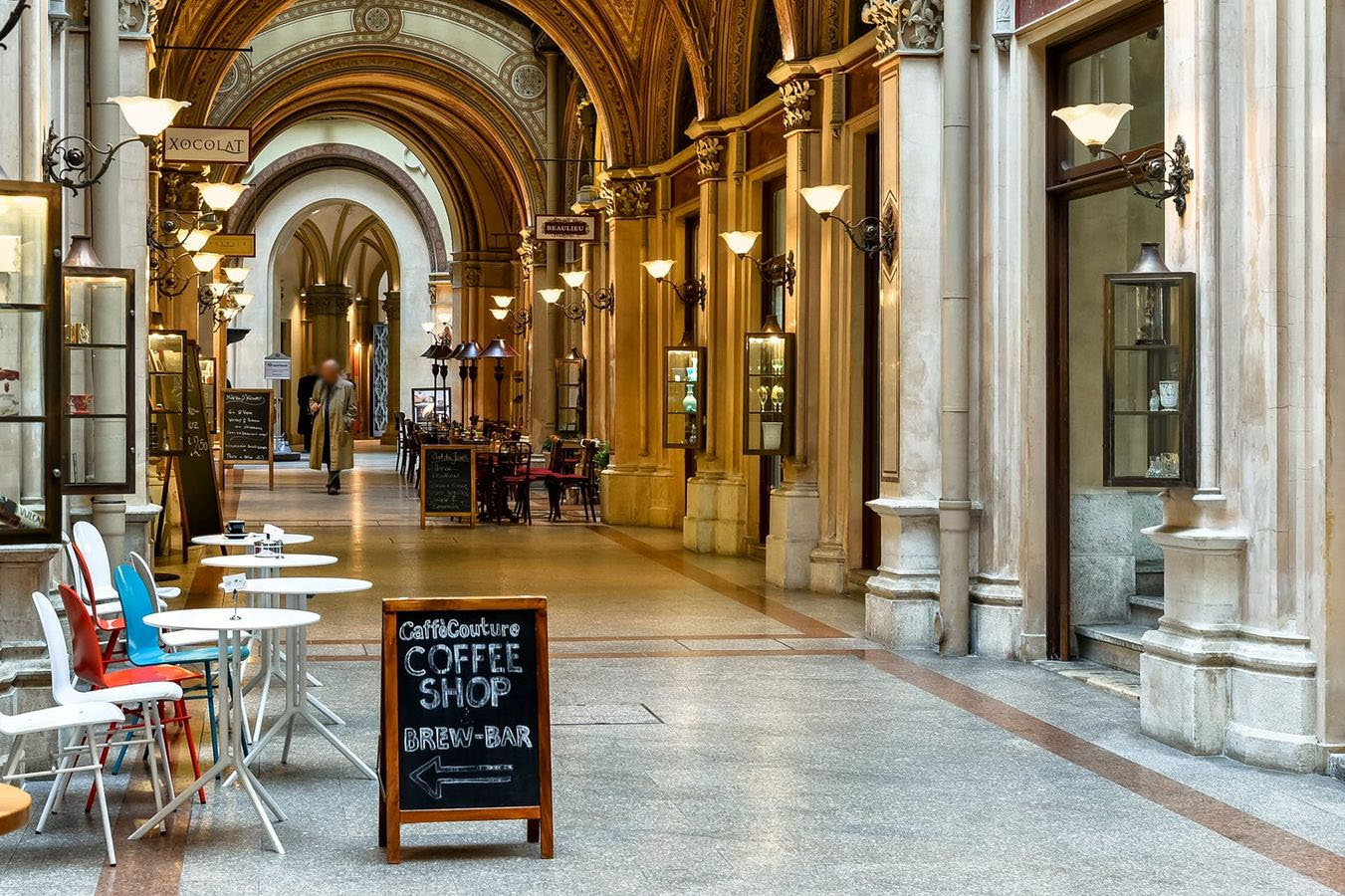
Vienna has spent centuries perfecting the art of looking important. Imperial palaces, monumental museums, Baroque churches and broad boulevards still give the Austrian capital the appearance of a city expecting the Habsburg court to return from lunch at any moment. The obvious sights deserve their reputation, but limiting Vienna to Schönbrunn, Klimt and coffee served by waiters who appear mildly disappointed in humanity misses a large part of the city.
Beyond the Ringstrasse, Vienna becomes less ceremonial and considerably more varied. Its Grätzel — small neighbourhoods without precise administrative boundaries, often centred on a market, square or cluster of streets — reveal a multicultural, creative and surprisingly youthful city. Add local wine, substantial Austrian food, nightlife beneath railway arches and an adult-entertainment scene with some well-known sauna clubs, and Vienna turns out to be rather more versatile than the imperial branding suggests.
For a first visit, start with the classics. Then get out of the centre.
Start with the Innere Stadt
Vienna’s first district, the Innere Stadt, contains an almost unreasonable concentration of major sights. Stephansdom, Hofburg, Albertina, the State Opera, Graben, Kohlmarkt and much of the Ringstrasse sit within or immediately around the historic core, making central Vienna exceptionally easy to explore on foot.
At its heart stands St Stephen’s Cathedral, or Stephansdom, whose coloured tiled roof and Gothic south tower are among the city’s defining images. The building combines Romanesque and Gothic elements accumulated over centuries, while its interior contains imperial tombs, chapels, religious art and access to the catacombs beneath. For views over central Vienna, the north tower has a lift while the south tower demands a climb of more than 300 steps. Vienna clearly believed panoramas should occasionally be earned.
From Stephansplatz, walk along Graben and Kohlmarkt toward the Hofburg. They are among Vienna’s principal shopping streets, but the architecture and urban setting make them worthwhile even if your contribution to the luxury-retail economy remains purely observational.
Hofburg: The Habsburg Headquarters
The Hofburg is less a palace than centuries of imperial expansion arranged around a series of courtyards. It served as the centre of Habsburg power for hundreds of years and today contains museums, official institutions, the Austrian National Library, the Spanish Riding School and the offices of the Austrian president.
The Imperial Apartments and Sisi Museum focus on Franz Joseph and Empress Elisabeth, while the Imperial Treasury is the stronger choice if crowns, regalia and objects designed to make absolute monarchy look properly impressive are more your thing. Among its treasures are the insignia of the Holy Roman Empire and Austrian imperial regalia. Trying to see every museum and historical room inside the Hofburg on the same visit is possible, but so is reading the collected works of Goethe during a lunch break.
Even without buying a ticket, the complex deserves time. Walk through Michaelerplatz, the courtyards and Heldenplatz and let the scale explain what centuries of imperial administration did to central Vienna.
Schönbrunn Palace
If the Hofburg was the political headquarters, Schönbrunn was the Habsburg summer residence, although the term “summer house” becomes slightly inadequate when applied to a palace with more than a thousand rooms.
The interiors are associated particularly with Maria Theresa, Franz Joseph and Empress Elisabeth, but Schönbrunn is as much about the surrounding park as the palace itself. Formal gardens, fountains, woodland, monuments and long avenues extend up the slope behind the building, culminating in the Gloriette, whose terrace provides one of the best views back across the palace toward Vienna.
Allow several hours. Schönbrunn does not combine gracefully with an itinerary containing four other major attractions and an optimistic restaurant booking at six.
Belvedere: Baroque Vienna and Klimt
The Belvedere was built for Prince Eugene of Savoy and consists of two Baroque palaces separated by formal gardens. Today it combines impressive architecture with one of Austria’s most important art collections.
Most visitors head to the Upper Belvedere for Gustav Klimt’s The Kiss, but there is considerably more here than one enormously successful piece of romantic merchandise. Schiele, Kokoschka and other major Austrian artists help tell the story of Vienna’s extraordinary artistic period around 1900, while the palace itself is one of the city’s finest Baroque ensembles.
Even if museum fatigue has already set in, the gardens and exterior justify the trip. From the upper part of the complex you also get an excellent view toward the centre.
Vienna’s Major Art Museums
Vienna has enough major collections to make attempting all of them on a short visit an act of self-harm disguised as cultural enthusiasm. Choose according to what you actually like.
The Kunsthistorisches Museum is the heavy artillery. Created to house the Habsburg collections, it contains Egyptian, Greek and Roman antiquities, decorative arts and a formidable painting collection featuring Vermeer, Velázquez, Caravaggio, Titian, Rubens and the world’s largest major collection of Pieter Bruegel the Elder. The building itself makes clear that nineteenth-century Vienna did not believe museums should suffer from modesty.
The Leopold Museum, inside the MuseumsQuartier, is particularly strong in Austrian modernism and contains the world’s largest collection of Egon Schiele alongside Klimt and other artists of the period. The Albertina, close to the State Opera, combines Habsburg state rooms with an enormous graphic-art collection and regularly important temporary exhibitions. Together with the Belvedere, these institutions make Vienna one of Europe’s strongest cities for anyone interested in art around 1900.
The MuseumsQuartier itself is also worth visiting without a ticket. Its former imperial stables now function as a large cultural complex whose courtyards are used for sitting, drinking and meeting people, proving that Viennese culture occasionally permits horizontal relaxation.
Karlskirche and Karlsplatz
South of the Ring, Karlskirche is Vienna’s great Baroque alternative to Stephansdom. Built after a plague epidemic in the early eighteenth century, its enormous dome, monumental portico and twin columns borrow freely from Roman architecture without becoming any less Viennese in the process.
The surrounding Karlsplatz deserves attention in its own right. Otto Wagner’s former Stadtbahn pavilions are outstanding examples of Viennese Jugendstil, while the rebuilt Wien Museum covers the city’s history from its early origins to the present. The square also provides a useful transition from monumental Vienna toward the smaller streets and contemporary culture of the Freihausviertel.
Prater and the Giant Ferris Wheel
The Prater is far larger than the amusement park most visitors associate with the name. Once an imperial hunting area, it combines extensive green space with the Wurstelprater, the historic entertainment zone near Praterstern.
Its most famous attraction is the Riesenrad, the Giant Ferris Wheel opened in 1897 and rising to almost 65 metres. The slow-moving cabins provide excellent views without requiring the modern amusement-park assumption that enjoyment should involve several G-forces and a realistic fear of mechanical catastrophe.
Beyond the rides, the Green Prater stretches for kilometres and is used for cycling, running and walking. It is one of the easiest places to escape Vienna’s monumental architecture without actually leaving the city.
Hundertwasserhaus
After several days of Habsburg symmetry, Hundertwasserhaus feels like architecture staging a small rebellion. Designed by Austrian artist Friedensreich Hundertwasser, the residential complex uses irregular floors, uneven windows, bright colours and extensive vegetation while displaying a deep suspicion of straight lines.
The apartments themselves are private, but the exterior is worth seeing and the nearby Kunst Haus Wien provides a much better introduction to Hundertwasser’s art, architecture and ecological ideas. It is an easy way to remind yourself that Austrian design did not end with imperial Baroque and Jugendstil.
Beyond the Ring: Vienna’s Grätzel
Vienna has 23 official districts, but everyday local geography often works on a smaller scale. A Grätzel is essentially a neighbourhood within a neighbourhood: several streets gathered around a market, square or local centre, generally without clearly defined borders.
Exploring them is one of the easiest ways to move beyond the capital’s monumental façade. Markets, small restaurants, independent shops, residential streets and neighbourhood bars replace the constant procession of palaces and museums. You do not need to collect Grätzel like train stations; choosing two or three provides a much better sense of modern Vienna.
Karmeliterviertel
Across the Danube Canal in Leopoldstadt, Karmeliterviertel combines Jewish history with one of Vienna’s most appealing market neighbourhoods. The Karmelitermarkt forms its centre, surrounded by cafés, restaurants and food shops, while kosher businesses and Jewish institutions remain part of the district’s identity.
Nearby Augarten offers an unusual mixture of Baroque landscaping, the historic Augarten porcelain manufactory and two enormous Second World War flak towers. The latter demonstrate that not every piece of twentieth-century concrete can be rescued by tasteful urban regeneration.
Yppenplatz and Brunnenmarkt
Further west in Ottakring, Brunnenmarkt and Yppenplatz show Vienna at its most multicultural. Brunnenmarkt stretches for almost a kilometre and is the city’s longest street market, with Turkish, Balkan, Middle Eastern and other culinary influences reflecting the surrounding population.
Around Yppenplatz, market stalls give way to cafés, restaurants and bars, while artists and younger residents have increasingly moved into the neighbourhood. Gentrification has followed with predictable enthusiasm, but the area still feels substantially different from central Vienna and remains one of the best places to see the city beyond its imperial image.
Spittelberg and Neubau
Behind the MuseumsQuartier, Spittelberg is a compact network of cobbled streets and Biedermeier houses. It was once a working-class district with a much rougher reputation and a visible prostitution scene; restoration and gentrification transformed it into one of Vienna’s most polished small neighbourhoods.
Continue into the wider 7th district, Neubau, and you find a younger Vienna of independent shops, cafés, design businesses, restaurants and bars around Mariahilfer Straße and its side streets. It is central enough to fit naturally into a first visit without feeling like another extension of the old town.
Freihausviertel and Naschmarkt
The Freihausviertel, centred around Schleifmühlgasse and the streets south of Karlsplatz, mixes galleries, vintage shops, restaurants, bars and classic Viennese establishments. Its proximity to Karlskirche and the centre makes it one of the easiest Grätzel to add to a conventional sightseeing day.
Next door is the Naschmarkt, Vienna’s best-known market, combining produce, food shops and restaurants with influences from Austria, the Balkans, the Middle East and Asia. It is famous and touristy, particularly around the restaurant section, but those two facts do not automatically render it useless. On Saturdays the adjoining flea market considerably increases both the atmosphere and the number of people examining objects nobody actually needs.
Vienna Is Still Growing
Not every interesting Viennese neighbourhood has several centuries of history. Sonnwendviertel, beside the Hauptbahnhof, is a large contemporary residential development built around Helmut-Zilk-Park, while Seestadt Aspern across the Danube is essentially an entire new urban district constructed around an artificial lake.
Neither is essential on a first weekend unless contemporary architecture and urban planning interest you. They are nevertheless useful reminders that Vienna is not simply maintaining an enormous nineteenth-century stage set; the city continues to expand well beyond the Ring and Gürtel.
What to Eat in Vienna
Viennese cooking was shaped by an empire that once extended across much of Central and Eastern Europe, so the local menu contains influences that do not always respect modern national borders.
The obvious starting point is Wiener Schnitzel, traditionally veal coated in breadcrumbs and fried until crisp, generally served with lemon and often potato or leaf salad. Pork versions are widespread but technically belong to the broader schnitzel family rather than being the traditional Wiener Schnitzel. Tafelspitz, boiled beef traditionally served with accompaniments such as horseradish and apple, is another classic closely associated with Vienna, while Gulasch reflects the Hungarian influence that became thoroughly integrated into Austrian cooking.
Soups remain surprisingly important. Frittatensuppe consists of clear broth with thin strips of sliced pancake, while Knödel appear in numerous forms and can accompany savoury dishes or become desserts. Potato salad — Erdäpfelsalat — is a common companion to schnitzel, and pasta dishes such as Schinkenfleckerl preserve the gloriously carbohydrate-heavy logic of Central European comfort food.
For something faster, use the Würstelstände scattered throughout the city. Vienna’s sausage kiosks are an institution rather than simply somewhere to eat when restaurants have stopped serving. Käsekrainer, filled with cheese, is particularly efficient at ensuring that nobody mistakes dinner for a wellness programme.
Coffee, Cake and the Viennese Approach to Time
Vienna’s coffee houses are not simply places selling caffeine. Historically they functioned as social clubs, offices, reading rooms and meeting places, and the tradition of lingering remains part of the experience.
Order a Wiener Melange, sit down and avoid behaving as though the table comes with a countdown timer. Sachertorte and Apfelstrudel are the obvious accompaniments, although Vienna has enough pastry traditions to make restricting yourself to the famous two unnecessarily disciplined.
The celebrated historic cafés can develop queues, particularly in the centre. There is no cultural prize for standing outside a famous coffee house for forty minutes when another very good one exists a few streets away. Vienna mastered cake long before social media arrived to rank it.
Wine Inside the City
One of Vienna’s more unusual characteristics is that substantial vineyards remain within the municipal boundary. Wine-growing districts on the northern and western edges of the city lead into hills overlooking the Danube and central Vienna.
Traditional taverns known as Heurigen serve local wine alongside cold dishes and simple Austrian food, particularly around areas such as Grinzing, Nussdorf and Neustift am Walde. For a longer stay, combining a walk through the vineyards around Kahlenberg with an evening at a Heuriger provides a very different version of the capital from the palaces and museums downtown.
Producing wine within the city limits is the sort of urban policy more capitals should investigate.
Vienna After Dark
Vienna’s nightlife is more substantial than its conservative reputation suggests. The Gürtel, particularly the venues beneath the elevated railway arches, has long been one of the main areas for clubs and live music, while the Danube Canal becomes a major drinking and socialising zone during warmer months. Neubau, the MuseumsQuartier and the Freihausviertel offer a more mixed evening of bars and restaurants, and Vienna has a well-established electronic-music scene for anyone unconvinced that an Austrian evening must end with a string quartet.
The scale and variety are enough to deserve a dedicated Vienna Nightlife guide. There is little benefit in squeezing individual cocktail bars, clubs and late-night venues into an article that already contains multiple imperial residences.
The Other Side of Vienna
Vienna also has a well-established adult-entertainment scene spread across several parts of the city rather than concentrated into one internationally famous red-light street. Laufhäuser, licensed adult clubs, erotic massage businesses and larger FKK/sauna-club formats all form part of the local landscape. Two of the better-known names are Saraya Club in Liesing, formerly known as Funpalast, and Goldentime in Simmering, both large establishments built around the sauna-club concept.
For Lonely Punter readers, this is clearly another part of Vienna worth knowing about rather than something to pretend does not exist. The individual venues, admission systems, current prices, facilities, etiquette and practical differences belong in a dedicated Vienna After Dark guide, where Saraya, Goldentime and the wider scene can be covered properly rather than reduced to an awkward paragraph here.
How Long Do You Need in Vienna?
Two full days are enough for the basic version: the historic centre, one imperial palace, one major museum and perhaps the Prater or a neighbourhood outside the Ring. It works, but requires choices.
Three days is a much better first visit. Schönbrunn can occupy the time it deserves, another major museum becomes realistic and there is still room for Karmeliterviertel, Neubau or the Naschmarkt area. With four or five days, Vienna stops being a sequence of famous buildings and becomes a city you can explore according to interest: vineyards, smaller Grätzel, nightlife, additional museums or the parts conventional guides generally postpone until page 300.
That is usually when Vienna becomes more interesting.
Vienna: The Bottom Line
Vienna earned its reputation through the Habsburgs, monumental architecture, classical music and collections built by rulers whose purchasing budgets would cause difficulties for a modern finance ministry. Schönbrunn, Hofburg, Stephansdom, Belvedere and the major museums remain genuinely exceptional rather than obligatory tourist chores.
The city becomes better, however, once those landmarks are mixed with the Vienna beyond the Ring: markets in Ottakring, Jewish history around Karmelitermarkt, bars under the Gürtel railway arches, vineyards on the edge of town, sausage stands after dark and neighbourhoods that barely resemble the imperial centre. Even the more unconventional adult side fits into the same picture: Vienna is a functioning modern capital, not a museum whose inhabitants have been instructed to remain in period costume.
It preserves its past exceptionally well. Fortunately, it has continued doing other things since.