Few Japanese experiences manage to be simultaneously as relaxing and as intimidating as an onsen.
The relaxing part is obvious: naturally heated water, mountain air, cedar baths, snow outside the window and the rare opportunity to spend an hour doing absolutely nothing productive. The intimidating part usually arrives five minutes earlier, when you are standing in a changing room wondering which curtain is the men’s entrance, whether the tiny towel is supposed to cover anything meaningful and why everyone else seems to understand a rulebook nobody gave you.
Fortunately, onsen etiquette is much simpler than it first appears. Wash before entering, keep towels and hair out of the water, don’t behave as though the bath is a swimming pool and accept that, in most traditional onsen, everyone is naked. Master those basics and the rest is mostly common sense.
What Exactly Is an Onsen?
The word onsen is usually translated as “hot spring”, but in Japan it has a legal definition rather than simply meaning a sufficiently warm bath. Under the Hot Spring Law, water emerging from underground can qualify as onsen if it reaches at least 25°C at the source or contains specified minerals above certain thresholds. That means an onsen does not technically need to emerge from the earth hot enough to boil anything important.
Japan’s geology has made these springs part of the country’s landscape and culture for centuries. They appear everywhere from volcanic valleys and ski resorts to coastal villages and traditional ryokan, and the water can look and smell dramatically different depending on its mineral content. Some baths are clear, others milky white, rust-red or faintly green; sulphurous springs can announce themselves to your nose well before the changing room does.
What makes the experience special is not simply sitting in hot water. Onsen culture combines bathing, relaxation, landscape and a set of rituals so familiar to Japanese bathers that nobody thinks to explain them until a confused foreigner walks into the wrong room wearing swimming shorts.
Onsen vs Sento: They Are Not the Same Thing
You will also encounter sento, traditional public bathhouses that look superficially similar. The important distinction is the water.
An onsen uses water that meets Japan’s legal hot-spring criteria. A sento is fundamentally a public bathhouse and can use ordinary heated tap water. Modern facilities occasionally blur the experience by adding saunas, cold pools, jet baths and elaborate bathing areas, but the underlying distinction remains.
This matters mostly if you are deliberately travelling for hot springs. If you simply want a hot bath and a glimpse of Japanese bathing culture, a neighborhood sento can be every bit as enjoyable and usually considerably easier to reach.
What Happens When You Arrive
The first few minutes differ slightly from one establishment to another, but the general sequence is remarkably consistent. Shoes usually come off near the entrance and go into a locker or shoe cabinet. You then pay admission, collect or rent towels if necessary and enter the appropriate changing room.
Look for 男 for men and 女 for women. Curtains are often color-coded too, but learning those two characters removes a surprisingly large amount of pre-bath anxiety.
Most changing rooms have lockers or baskets for clothes and valuables. Remove everything before entering the bathing area, including underwear and usually watches and jewelry. Mineral-rich water can discolor some metals, so your expensive watch does not need to share the spiritual experience.
Take only the small towel into the bathing area. The large towel stays dry in the changing room for afterwards.
Yes, You Will Usually Be Naked
Traditional public onsen are normally enjoyed completely naked. Swimming trunks, underwear and improvised attempts at modesty are generally not part of the arrangement.
The first visit can feel strange if communal nudity is not part of your normal Tuesday afternoon, but the awkwardness tends to disappear remarkably quickly. Nobody is there to inspect you. People wash, soak, stare into the middle distance and generally demonstrate the same level of interest in strangers’ bodies that commuters show in other people’s shoes.
A small towel can be used for a little modesty while walking between the washing area and the bath. Just don’t put it into the bathwater. Fold it beside the tub or perform the traditional balancing act and place it on your head.
Most public baths are separated by gender. Mixed bathing, or konyoku, still exists in some places but is much less common, and individual facilities may have their own rules about towels or bathing garments. Never assume that a swimsuit is allowed simply because the bath is mixed.
If communal nudity genuinely does not appeal, look for a private bath, usually described as kashikiriburo or kazokuburo. Many ryokan rent them for a fixed period, and some rooms come with their own private indoor or open-air bath. You still follow the washing rules, but at least the only person judging your towel technique is you.
Wash First, Soak Second
This is the rule that matters most.
The large bath is for soaking, not washing. Before you enter it, sit at one of the washing stations arranged around the bathing room. These normally provide a low stool, shower, bucket and often shampoo and body soap. Wash yourself thoroughly and rinse off all soap before approaching the bath.
You may also see people pour warm water over themselves immediately before entering. This is known as kakeyu. Apart from being part of the bathing ritual, it helps your body adjust gradually to the temperature.
Do not stand up and spray half the room while showering. The stools exist for a reason, and nobody needs to receive an unexpected pressure wash while contemplating inner peace.
Once you are clean, you can move between the different baths without repeating the entire shower ritual every time. If you have been sweating heavily in a sauna, however, rinse before getting back into the shared water.
The Small Towel Has One Important Rule
The tiny towel causes more confusion than an object of that size reasonably should.
Use it to wash, carry it for modesty or put it on your head. What you do not do is soak it in the communal bath. The same principle applies to long hair: tie it up so that it does not float in the water.
Phones and cameras should stay outside the bathing area. Even if the room is empty and the mountain view is magnificent, a public space full of naked strangers is not where your travel photography portfolio needs to make a breakthrough.
Swimming, diving and putting your head underwater are equally unnecessary. An onsen is a bath, not a leisure pool.
How Hot Is an Onsen?
There is no single temperature.
Many baths sit somewhere around the high 30s to low 40s Celsius, but hotter springs certainly exist. Some facilities offer several tubs at different temperatures, along with cold baths, saunas and outdoor pools.
Do not feel obliged to remain submerged because the seventy-year-old man beside you appears perfectly comfortable. He may have been doing this since childhood. You have been doing it for six minutes.
Enter slowly, especially if the water is hot, and get out before dizziness turns relaxation into an administrative problem for the staff. Short repeated soaks are usually more pleasant than trying to prove that you can be slowly poached.
Hydration matters too. Drink water before and after bathing, and avoid entering a very hot bath immediately after consuming a heroic quantity of alcohol. Japanese bathing culture is deeply compatible with a drink afterwards; combining drunkenness with prolonged exposure to very hot water is a less elegant tradition.
Indoor Baths, Rotenburo and Private Baths
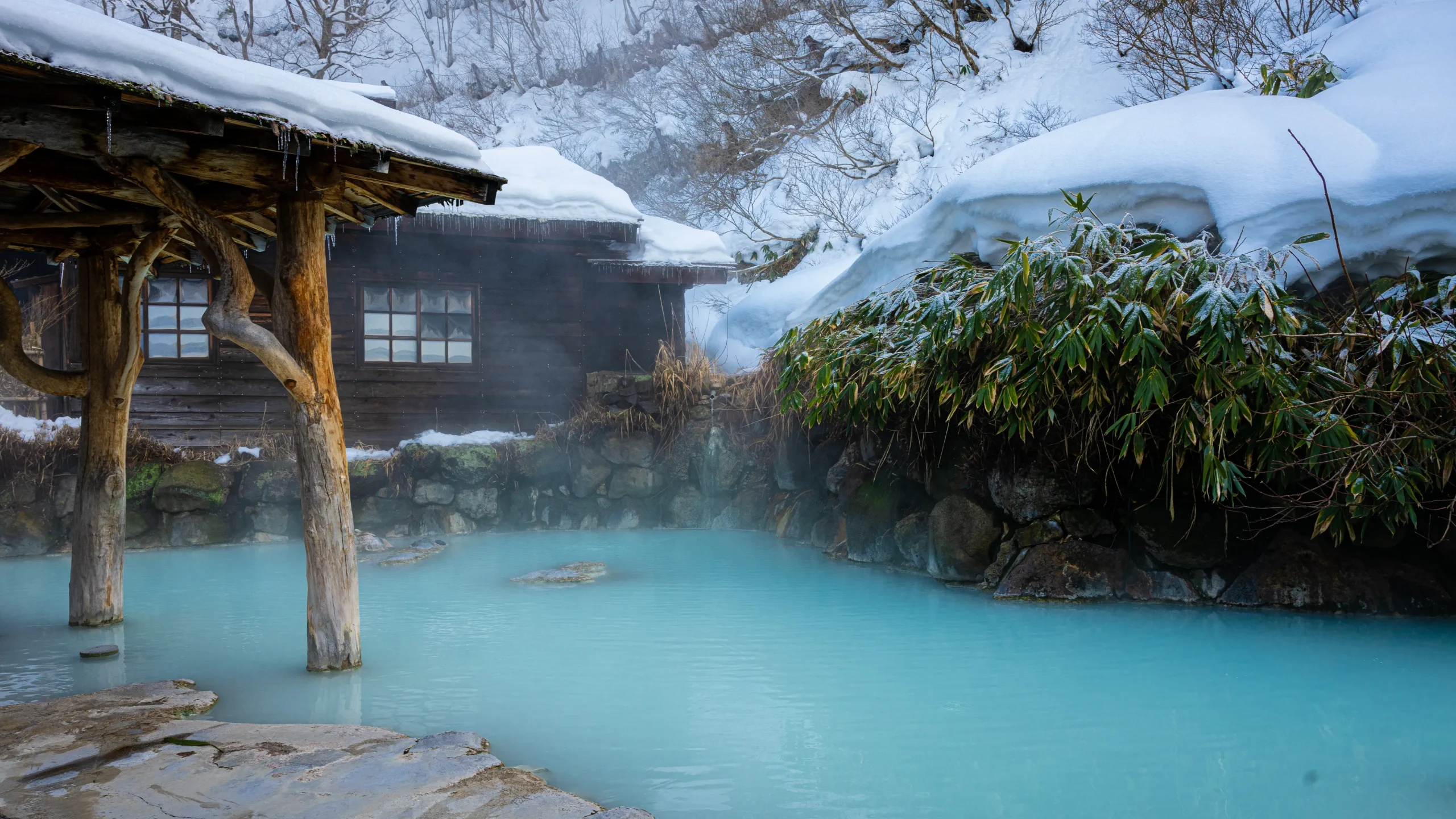
The classic indoor onsen may use stone, tile or fragrant hinoki cypress, but the most memorable baths are often rotenburo: open-air pools surrounded by gardens, mountains, forest or snow.
Winter is especially good at explaining why these became an obsession. Sitting in steaming water while snow settles around the edge of the bath feels extravagant even when the admission ticket cost less than lunch.
Private outdoor baths can be even better if the setting is right, although privacy generally costs more. Some ryokan also rotate men’s and women’s bathing areas at different times of day, giving overnight guests the opportunity to try both sides. Check the signs rather than relying on where you went six hours earlier.
There are also much stranger variations. Ibusuki in Kyushu is famous for sand baths heated by geothermal water, while Hirauchi Kaichu Onsen on Yakushima consists of natural seaside pools that are accessible only around low tide. Japan was never going to stop at “large tub of hot water”.
Tattoos: Check Before You Go
This is one of the few areas where there is no rule that works everywhere.
Tattoos have historically been associated in Japan with organised crime, and many communal bathing facilities still restrict tattooed guests. Attitudes are changing, but assuming that every onsen now accepts tattoos is an excellent way to arrive naked at an argument you could have avoided online.
Policies vary enormously. Some facilities allow tattoos without restriction, some allow small tattoos if covered with approved patches, some require a private bath and some still refuse entry entirely.
Check the establishment’s current policy before visiting.
There are notable exceptions. Kinosaki Onsen’s public bathhouses explicitly welcome tattooed bathers, making the town particularly straightforward for visitors with extensive tattoos. Kurama Onsen near Kyoto also currently states that tattooed guests are welcome.
If the rules are unclear, ask rather than trying to smuggle a full back piece past reception beneath three waterproof plasters.
What About the Famous Onsen Health Benefits?
Onsen waters contain different mineral compositions, and Japanese facilities commonly display detailed information about the source, water chemistry and recognised bathing indications. Sulphur, chloride, iron and other mineral-rich springs can feel very different on the skin.
Enjoy the water for what it is, but keep the medical claims in perspective. “Onsen” is a geological and legal classification, not a guarantee that sitting in a hot pool will repair every organ you have mistreated since university.
Facilities also display contraindications and bathing precautions for a reason. Anyone with relevant medical conditions should follow those warnings and seek appropriate medical advice rather than relying on the enthusiastic promises of a hotel brochure.
Should You Shower After an Onsen?
This is less absolute than some traditional guides make it sound.
Many bathers prefer not to rinse after their final soak, allowing the mineral water to remain on the skin. Others take a final shower. Japanese official guidance treats this as largely a matter of preference, although strongly acidic, sulphurous or otherwise irritating water can be uncomfortable for sensitive skin, in which case rinsing makes sense.
Follow any specific advice displayed by the facility. The spring itself knows more about its chemistry than a generic rule you read on the internet.
Before returning to the changing room, use the small towel to remove excess water so you do not create a miniature flood across the floor. Then dry properly with the large towel.
How Long Should You Spend at an Onsen?
There is no prize for endurance.
A simple visit can last less than an hour, while a large day spa or onsen town can easily occupy half a day. The actual time spent submerged is usually broken into several shorter sessions, particularly when the water is hot.
An overnight stay in an onsen ryokan is a different experience altogether. You can bathe before dinner, again later in the evening and then once more early in the morning when the bath may be almost empty. Three baths in less than twenty-four hours would sound excessive anywhere else; inside a ryokan it somehow becomes efficient time management.
Onsen towns make the experience broader still. You can wander between public baths in a yukata, stop for food, explore the surrounding streets and then repeat the entire process until you begin to suspect your normal life contains insufficient hot water.
How Much Does an Onsen Cost?
Prices vary too much across Japan for a single number to be especially useful.
Simple public or municipal baths can still cost well under ¥1,000. Larger day-use facilities, resort onsen and hotel spas can run into the low thousands of yen, while private baths add another charge and luxury ryokan operate in an entirely different financial ecosystem.
Towels may be included, rented separately or not provided at all. Small local baths are the most likely places to require you to bring your own.
If you are visiting an onsen town, look for bathing passes. Kinosaki, Kurokawa and other established hot-spring destinations offer systems designed specifically for bath-hopping, usually making more sense than paying separately if you intend to spend the day systematically turning yourself into soup.
When Is the Best Time to Visit?
There is no bad season, but winter has an unfair advantage.
A rotenburo surrounded by snow is one of the great Japanese travel experiences, particularly in northern Honshu and Hokkaido. Autumn foliage provides its own spectacular backdrop, while spring can combine hot springs with cherry blossom country.
Summer is perfectly valid too, especially in mountainous areas where evenings are cooler, although the psychological appeal of entering 41°C water is admittedly easier to understand when the air temperature is not already doing something similar.
Golden Week, New Year and other major Japanese holiday periods can bring higher prices and heavier demand. Famous onsen towns and sought-after ryokan may need to be booked well in advance.
Onsen Etiquette in About Thirty Seconds
If you remember nothing else, remember this sequence:
- Take off your shoes where required, enter the correct changing room and undress completely. Wash thoroughly before entering the bath. Keep your small towel and your hair out of the water, speak quietly, don’t swim, don’t photograph the bathing area and get out if you feel overheated. Check tattoo policies before you arrive, and follow any facility-specific instructions even if they differ from something you have read elsewhere.
That is essentially it. The Japanese have surrounded communal bathing with etiquette, but not with a secret initiation ceremony. You do not need to perform every movement with the precision of someone born in an onsen town.
Cleanliness and consideration will get you through almost everything.
Where to Try Onsen in Japan
Kinosaki Onsen, Hyogo
Kinosaki is perhaps the easiest place to understand the idea of an onsen town. Ryokan line the river, visitors walk between public bathhouses in yukata and bathing is the main event rather than something squeezed between sightseeing stops.
Its public baths are also explicitly tattoo-friendly. In 2026 some individual bathhouses have temporary renovation closures, so check the current schedule before building an ambitious seven-bath campaign.
Nyuto Onsenkyo, Akita
Deep in the mountains near Lake Tazawa, Nyuto Onsenkyo consists of several historic hot springs scattered through forest in Towada-Hachimantai National Park. Tsurunoyu is the most famous, known for its rustic buildings and opaque milky water.
This is the version of onsen culture that photographs have been promising you: forests, steam, old wooden buildings and enough distance from central Tokyo that nobody is going to casually drop in between meetings.
Dōgo Onsen, Matsuyama
Dōgo is one of Japan’s great historic hot-spring destinations, with the castle-like Dōgo Onsen Honkan at its centre. Following years of conservation work, the full building reopened in 2024.
Come here less for wilderness and more for the history of communal bathing itself. The building is part bathhouse, part architectural landmark and proof that people have been taking relaxation very seriously in Matsuyama for a long time.
Aoni Onsen, Aomori
Aoni Onsen is for anyone who looked at ordinary rural Japan and decided it still had excessive connectivity. Hidden in the mountains of Aomori, the ryokan is famous for its remote setting, multiple baths and evenings illuminated by oil lamps.
This is not where you go because you need twenty restaurant choices and reliable nightlife. You go because for once there is almost nothing to do except eat, bathe and discover that silence is still commercially available.
Ibusuki, Kagoshima
Ibusuki takes geothermal bathing and adds a shovel.
Its famous sunamushi sand baths involve changing into a yukata, lying on naturally heated beach sand and allowing staff to bury you up to the neck. Afterwards you wash off the sand and use a conventional onsen.
It looks ridiculous right up until the moment you are lying there wondering why ordinary spas never thought of burying their customers alive.
Kurama Onsen, Kyoto
Kurama makes an easy mountain escape from central Kyoto and combines a forested setting with indoor and outdoor bathing. The complex reopened in late 2024 after several years of closure and is once again operating for day visitors and overnight guests.
The current facility explicitly allows tattoos, which removes one of the main uncertainties for international visitors. Pair it with Kurama-dera or the surrounding mountain walks and you have a very convincing excuse to leave central Kyoto’s temple crowds for a day.
Hirauchi Kaichū Onsen, Yakushima
For something considerably less conventional, Hirauchi Kaichū Onsen lies directly beside the sea on Yakushima. Natural rock pools fill with hot spring water but disappear beneath the ocean at high tide, meaning access is limited to a few hours around low tide.
It is mixed-gender, has no conventional changing rooms and does not permit swimsuits. A small donation supports its upkeep.
Nobody can accuse it of lacking commitment to the concept.
The First Visit Is the Hardest
Most anxiety about onsen disappears the moment you actually enter one.
The ritual is unfamiliar but straightforward: undress, wash, soak, keep the water clean and avoid behaving like the main character in the room. Once you have done it once, the mysterious rules quickly become habits.
After that, the problem tends to reverse. Instead of worrying about whether you know how to use an onsen, you start examining every Japanese itinerary for opportunities to insert another one.
That is how it gets you.