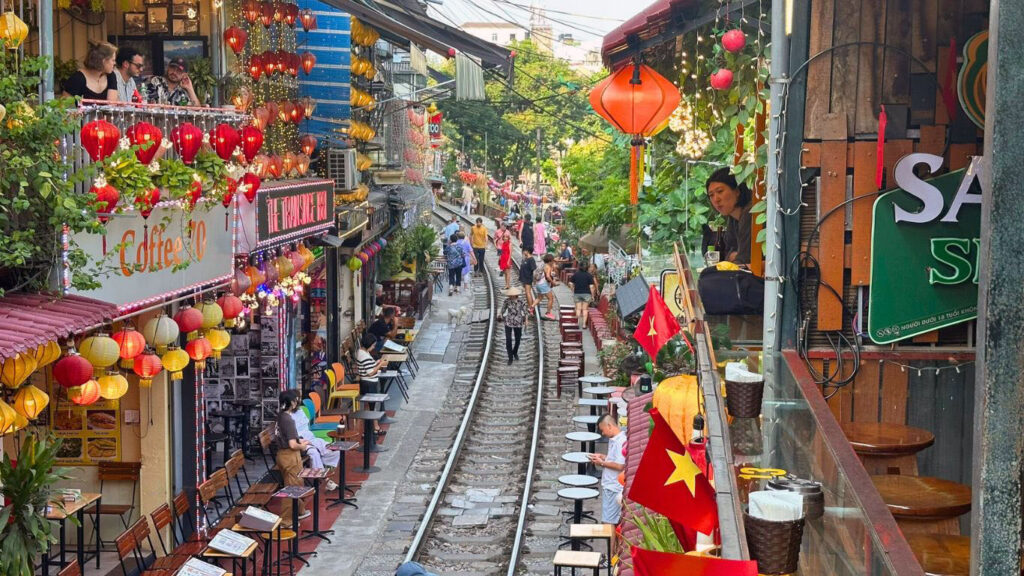
Hanoi is often described as more conservative after dark than Ho Chi Minh City, which is technically true and not especially useful. The capital still has an extensive nightlife scene; it simply spreads itself across different neighbourhoods and changes character far more dramatically from one area to another.
One evening can begin on a rooftop overlooking the Old Quarter, move to a plastic stool for fresh beer, continue with a serious cocktail hidden behind an unmarked doorway and finish several hours later in a techno room beside West Lake. Another can involve jazz, craft beer and no nightclub whatsoever. Hanoi nightlife works best once you stop looking for a single entertainment district and understand the geography.
The main areas to know are the Old Quarter and Hoàn Kiếm, Trúc Bạch and Ba Đình, and Tây Hồ around West Lake. Each serves a different purpose, and choosing the right one matters considerably more than collecting a list of supposedly essential bars.
Old Quarter: Start Where Hanoi Is Loudest
For most first-time visitors, the Old Quarter is the natural starting point. It is compact, walkable and packed with bars, restaurants, cafés, rooftop terraces and small clubs, with very little need for transport once you are inside it.
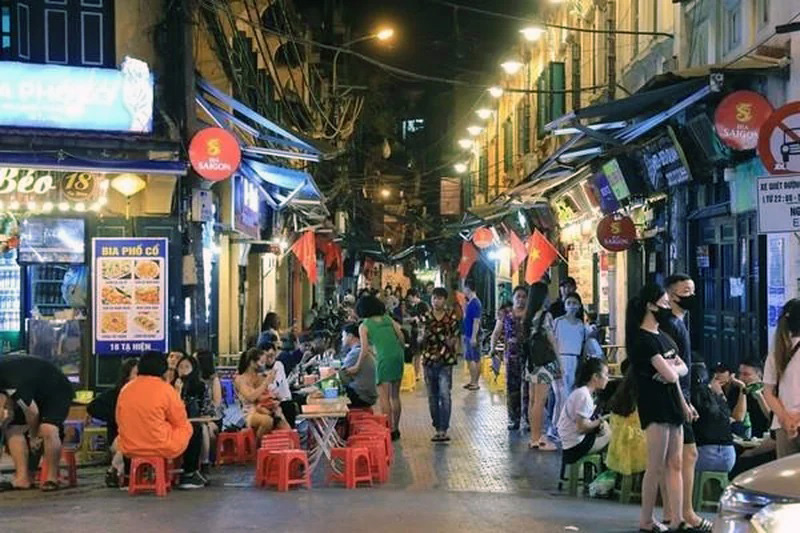
The centre of gravity is Hàng Buồm and Tạ Hiện, particularly the streets around the junction of Tạ Hiện and Lương Ngọc Quyến. By early evening plastic stools begin spreading across the pavement, food stalls get busy and the narrow lanes fill with a mixture of Vietnamese students, domestic visitors, backpackers and international travellers.
Tạ Hiện is usually described as Beer Street, although anyone expecting a romantic preservation of traditional bia hơi culture may be surprised by the quantity of branded beer, bright signage and tourists. It is noisy, crowded and blatantly commercial. It is also fun when approached on its own terms.
Sit down, order a beer and stay long enough to absorb the scene rather than spending three hours defending the same plastic stool. The point of Tạ Hiện is not finding Hanoi’s greatest drinking establishment; it is experiencing a piece of street-level nightlife that would be difficult to reproduce anywhere tidier.
Bia Hơi: The Hanoi Drinking Institution
Bia hơi is fresh draught beer produced for rapid local consumption rather than long storage. It is light, inexpensive and historically associated with uncomplicated neighbourhood drinking rather than sophisticated beer appreciation.
The traditional setup is brutally efficient: tiny stools, simple food, glasses arriving quickly and groups sharing tables close enough that social interaction requires very little deliberate effort. In the Old Quarter, the experience has become more tourist-oriented, but bia hơi remains an important part of Hanoi’s drinking culture.
Do not assume every beer served on Tạ Hiện is bia hơi simply because you are sitting on a plastic chair. Tiger, Hanoi Beer and other bottled or keg products are everywhere. If trying the fresh version matters to you, ask for bia hơi specifically.
The format also makes Hanoi relatively easy for someone going out alone. Sitting at a communal street table is much less conspicuous than occupying a restaurant table by yourself while pretending to conduct urgent research on your phone.
Hàng Buồm After the First Beer
Hàng Buồm broadens the Old Quarter night beyond Beer Street. Bars, casual restaurants and louder late-evening venues spill into the surrounding lanes, so walking a few minutes away from Tạ Hiện often produces a better night than remaining at its most congested intersection.
This is also where the Old Quarter’s mixture of local and international nightlife becomes clearer. One doorway may contain a cheap beer bar, the next a cocktail room with carefully measured ingredients, while a club sits several buildings farther along. Hanoi does not seem particularly troubled by consistency.
The practical advantage is density. If a bar is empty, unpleasant or inexplicably playing the same remix for the fourth time, leave. Another option is probably less than two minutes away.
1900 Le Théâtre: The Old Quarter’s Main Club
If you want a conventional nightclub without leaving the Old Quarter, 1900 Le Théâtre remains the obvious name. Located directly on Tạ Hiện in a former theatre space, it has developed into one of Hanoi’s best-known clubs, mixing Vietnamese and international crowds with electronic music, V-pop remixes, hip-hop and guest DJs.
The room is substantially more polished than the beer bars outside, with large-scale visuals and a proper club sound system. Events vary considerably: some nights are straightforward commercial clubbing, while others involve named DJs, themed parties or special entrance arrangements.
Do not rely on a permanently fixed cover charge or closing hour. The club continues to run a changing event programme in 2026, and entry conditions differ according to the night. Check the current event before going rather than quoting a blog post written three governments of smartphone ago.
1900 works especially well as the transition point between the street and the club. You can spend the first half of the evening drinking cheaply around Tạ Hiện and then walk several metres into something dramatically more elaborate.
Hoàn Kiếm Lake: Rooftops, Cocktails and a More Civilised Start
The southern side of the Old Quarter and streets around Hoàn Kiếm Lake provide a more polished version of central Hanoi nightlife. Around Đông Kinh Nghĩa Thục Square the evening begins with crowds, cafés and pedestrian activity, while the streets farther south contain hotel rooftops, cocktail bars, restaurants and live music.
This is the better starting point if your idea of a good evening does not involve immediately placing your knees somewhere near your ears on a plastic stool.
Weekend nights are particularly good around the lake because pedestrianisation changes the centre completely. Families, performers and groups of young Vietnamese take over spaces normally dominated by traffic, so simply walking around Hoàn Kiếm before choosing a bar is worthwhile.
From here you can still reach Tạ Hiện in minutes. Hanoi allows you to move from rooftop martini to pavement beer without requiring a taxi or a change of clothes, which is an underappreciated form of urban planning.
Start With a Rooftop at Sunset
Hanoi does not have Bangkok’s vertical skyline, but its rooftops compensate with something more interesting at street level: dense tiled roofs, church towers, Hoàn Kiếm, the Red River and the apparent electrical improvisation of the Old Quarter below.
Moonlight Sky Bar, on top of La Siesta Classic Ma May, remains a good central choice. It opens daily from 17:00 until midnight and gives broad views across the Old Quarter toward Hoàn Kiếm, Long Biên Bridge and the Red River.
Lighthouse Sky Bar, at 27 Hàng Bè, follows a similar schedule and currently runs a daily happy hour from 17:00 to 18:30 on selected drinks. Its elevated terrace works particularly well as the first stop of the night because you can descend directly into the Old Quarter afterwards.
Rooftop drinks cost considerably more than bia hơi. This is not evidence of a scam; elevators and panoramas have traditionally complicated beverage economics.
Hanoi’s Cocktail Scene Is Better Than You Might Expect
The largest change in Hanoi nightlife over the past decade has been the development of a genuinely serious cocktail scene. The city now has small speakeasies, internationally recognised bars and bartenders using Vietnamese ingredients without treating lemongrass as an exotic decorative revelation.
Local flavours appear in increasingly sophisticated ways: mắc khén mountain pepper, galangal, coriander, tropical fruit, rice spirits, Vietnamese coffee, pandan and the spices associated with phở. A handful of bars have gone even further and turned phở itself into a cocktail vocabulary involving star anise, cinnamon and other savoury elements.
The results range from excellent to drinks that make an admirable intellectual argument for ordering whiskey instead. Experimenting is part of the appeal.
Polite & Co for Classic Cocktails
Hidden in a lane near Hoàn Kiếm, Polite & Co is one of Hanoi’s established cocktail institutions. The interior leans toward the gentleman’s-club end of the speakeasy spectrum, with dark timber, subdued lighting, whisky and a rotating cocktail programme.
It is an easy place to recommend after dinner because it feels removed from the Old Quarter despite being only minutes away. Current schedules vary slightly between listings, but it generally opens in the late afternoon and runs until around midnight or 01:00 depending on the day.
The house drinks regularly use Hanoi or Vietnamese references, but you do not need to order the most conceptually ambitious item on the menu. A bartender capable of building a cocktail around local herbs is usually also capable of making a competent Old Fashioned.
Bee’Znees 1920s for the Hidden-Bar Experience
Bee’Znees 1920s on Phùng Hưng commits more enthusiastically to the speakeasy idea. Entry is concealed behind a bookshelf, after which the bar opens into a retro-styled space built around classic and signature cocktails.
It remains active in 2026 and runs live music on selected nights alongside other recurring events. Current promotions include happy-hour offers before 21:00 and after midnight on certain days, although these are precisely the sort of details worth checking before constructing an evening around them.
Bee’Znees is a useful contrast with Tạ Hiện because the two places could hardly approach alcohol more differently while sitting in the same part of Hanoi. One puts hundreds of people on the street; the other hides the entrance.
The Haflington and Hanoi’s New Cocktail Ambition
For a more ambitious cocktail evening, The Haflington on Hàng Mã has become one of Hanoi’s most recognised bars. The space is theatrical without becoming a nightclub, with dark interiors, unusual display pieces and a menu aimed firmly at drinkers who consider cocktails an activity rather than a preliminary step.
It has also helped put Hanoi on the international bar map. Prices are correspondingly higher than pavement drinking, with current cocktails broadly in the 200,000–400,000 VND territory depending on what you order.
Booking ahead is sensible on busy evenings. There are worse problems to have than discovering that Hanoi now contains cocktail bars popular enough to reject your spontaneous arrival.
Try a Vietnamese-Inspired Cocktail
If you want something specifically tied to Hanoi rather than another competent Negroni, look for bars working deliberately with Vietnamese ingredients. Nê Cocktail Bar is particularly associated with its Phở Cocktail, which takes the aromatic language of the soup — spices such as star anise and cinnamon — and converts it into a drink.
Other modern bars use green rice, pepper, herbs, fermented ingredients, coffee and regional produce. These are generally more interesting than simply adding passion fruit to vodka and declaring the result Asian.
You do not need to spend the entire night conducting liquid anthropology. One adventurous cocktail is usually enough to determine whether dinner flavours improve when alcohol becomes involved.
Live Music and Jazz Around the Centre
Hanoi’s live-music scene is fragmented rather than concentrated in one entertainment district. The best-known longstanding name is Bình Minh Jazz Club, close to the Opera House, associated with saxophonist Quyền Văn Minh and still active in 2026.
Jazz provides a useful alternative when the idea of another DJ set feels premature. The wider Opera House and French Quarter area also has hotel bars and more formal lounges aimed at an older and generally better-dressed crowd than Tạ Hiện.
Check programmes rather than assuming live music every evening at the same time. Hanoi nightlife rewards mild planning once you move away from beer streets.
Trúc Bạch and Ba Đình: Craft Beer Without the Beer Street
North of the historic centre, Trúc Bạch and Ba Đình provide a noticeably calmer drinking environment. The lake and surrounding residential streets attract foreign residents, Vietnamese regulars and people who have already established that Tạ Hiện exists and feel no urgent need to confirm it again.
Standing Bar, overlooking Trúc Bạch Lake, is the obvious reference point for craft beer. It operates as a free house rather than pushing a single brewery, with numerous Vietnamese craft taps, regular vinyl DJ nights, live performances and comedy events.
It currently opens until midnight, later in spirit than in paperwork. This is an excellent area for beginning a night with good beer and conversation before deciding whether you actually require a nightclub.
The neighbourhood also works for solo travellers because sitting at a craft-beer bar requires no group choreography. If conversation happens, fine. If it does not, the beer remains functional.
Tây Hồ: Hanoi’s Expat and Underground Nightlife
Tây Hồ, wrapped around the eastern side of West Lake, feels like a different city after dark. The streets are more spread out, the venues generally larger and the crowd contains a high proportion of foreign residents alongside affluent and internationally minded Vietnamese.
You will find sports pubs, wine bars, craft beer, restaurants, lakeside terraces and some of Hanoi’s most important electronic-music venues. Unlike the Old Quarter, you cannot sensibly treat Tây Hồ as one compact pedestrian nightlife district; distances add up quickly, so use Grab between venues when necessary.
The trade-off is space. After several evenings in the Old Quarter, discovering a bar in which another customer’s elbow is not an architectural feature can feel unexpectedly luxurious.
Savage for Serious Electronic Music
Savage is Hanoi’s most internationally recognised underground electronic-music venue. It has built its reputation around house, techno and related electronic styles rather than mainstream EDM, attracting Vietnamese DJs, regional artists and international guests.
The programme is event-led, and weekend nights can run very late. Current listings on Savage’s own site show events extending to around 05:00, with individual rooms and line-ups running on different schedules.
This is not the place to go simply because “we need a club after Beer Street”. Go because you actually want electronic music. There is nothing wrong with commercial EDM, but wandering into a five-hour techno programme while hoping for Rihanna creates avoidable disappointment.
Mirage for a Smaller Underground Alternative
Also in Tây Hồ, Mirage occupies a smaller part of Hanoi’s underground electronic ecosystem. Its nights range across house, techno, hypnotic and more experimental sounds, often with local selectors mixed with visiting DJs.
Recent 2026 schedules show late Friday and Saturday events, in some cases running into the early morning. As with Savage, the programme matters more than the venue name, so check who is playing before travelling across West Lake.
Tây Hồ clubbing is generally more music-led and less focused on bottle-service spectacle than Hanoi’s large commercial clubs. That distinction becomes useful at 01:30.
Hero Club for Late Commercial Clubbing
Hero Club occupies another side of Hanoi club culture. Currently located on Yên Phụ, it is a large, high-energy EDM and open-format club built around DJs, tables and bottle service rather than underground credibility.
Its official current schedule runs from 21:00 to 03:00 every night. Groups can book standing, bar or VIP tables, although simply going for the dance floor is possible depending on the event and entry conditions.
Hero is useful when the Old Quarter is winding down but nobody involved has displayed the good judgement required to go home. It is also much closer to the centre than some deeper Tây Hồ venues.
Vietnamese Commercial Clubs Work Differently
Hanoi also has a large category of Vietnamese commercial clubs that do not neatly resemble Western dance clubs. Many revolve around groups booking standing tables, ordering bottles, fruit and mixers, while DJs play extremely loud Vina House, EDM or Vietnamese remixes under elaborate LED displays.
The atmosphere can feel closer to collective table partying than a dance floor where everybody independently wanders around. Arriving alone and expecting the room to work like a European nightclub may therefore feel slightly awkward, while arriving as a group makes considerably more sense.
Bottle prices vary enormously and can dominate the cost of the evening. If a club is built around tables, ask what minimum spend applies before sitting down rather than discovering that a chair has developed financial consequences.
The “Midnight Curfew” Is More Complicated in 2026
Older Hanoi nightlife guides often describe a straightforward rule: everything in the Old Quarter shuts at midnight, shutters come down and anybody still drinking is participating in a minor act of resistance.
That description is now too simple.
Hanoi adopted a new night-economy framework in 2026. Under the current regulations, authorised night-economy areas and businesses can operate from 22:00 until 02:00, while selected specially approved locations can potentially operate from 22:00 until 06:00 when they meet stricter conditions relating to security, noise, fire safety and urban management.
This does not mean every Old Quarter bar may suddenly stay open until dawn. Individual licences, neighbourhood restrictions and enforcement still matter, and plenty of places continue to close around midnight. What has changed is that “midnight is the law everywhere” is no longer an accurate way to understand Hanoi nightlife.
The practical lesson is simple: check the venue. A rooftop may close at midnight, a cocktail bar at 01:00, Hero at 03:00 and an electronic event in Tây Hồ several hours later.
Do Bars Still Close Their Shutters and Carry On?
Sometimes, yes. Hanoi’s old ritual of dimming lights, lowering shutters and quietly continuing service has not vanished entirely.
It should not, however, be treated as a tourist attraction or as evidence that a venue is somehow more authentic. If staff are clearly trying to conceal operation from authorities, you are drinking in a business choosing to operate outside whatever conditions apply to it that night.
There are now enough legitimate late-opening clubs and authorised venues that hunting for a semi-closed bar behind a metal shutter is unnecessary unless the evening has already begun making poor decisions on your behalf.
A Good Friday or Saturday Night in Hanoi
Start early enough to enjoy the city changing rather than emerging from a hotel at 23:00 and demanding immediate nightlife.
Around 17:30, take a rooftop. Lighthouse works particularly well because its current happy hour runs from 17:00 to 18:30, while Moonlight provides broad views over the Old Quarter. Have one drink, watch the light disappear and leave before rooftop pricing begins to convince you that altitude improves thirst.
At roughly 19:30 or 20:00, walk into Hàng Buồm and Tạ Hiện. Eat something simple, have a bia hơi or bottled beer and spend an hour in the street atmosphere. This is when Beer Street is most useful: busy enough to be entertaining without necessarily having reached full compression.
Around 21:30 or 22:00, change tone. Polite & Co, Bee’Znees, Nê or The Haflington give you an hour of proper cocktails and air conditioning before the late part of the night.
After 23:30, choose according to what you actually want. Stay central for 1900 and commercial clubbing, head toward Hero for a large EDM room, or use Grab to Tây Hồ for Savage or whichever underground event has the best programme that night.
Trying to visit all of them would not demonstrate sophisticated knowledge of Hanoi nightlife. It would demonstrate that you have misunderstood the purpose of chairs.
Going Out Alone in Hanoi
Hanoi is unusually manageable for independent nightlife because so much of the early evening occurs in places where arriving alone does not look unusual. Beer Street, rooftops, cocktail bars, craft-beer counters and live-music venues all work without a group.
Tạ Hiện is the easiest place to fall into conversation because seating is compressed and people move constantly between tables. Trúc Bạch is better if you prefer actual conversation rather than negotiating against music and several hundred neighbouring conversations.
Commercial table-service clubs are the least natural environment alone, while Savage and other music-focused venues work perfectly well if you genuinely care about the music. Choose somewhere you would still enjoy if you spoke to nobody. Curiously enough, that usually makes you easier to talk to.
Getting Around After Dark
Walk within the Old Quarter and around Hoàn Kiếm. Distances are short, traffic frequently makes cars slower than feet and moving between venues is part of the experience.
For Trúc Bạch, Tây Hồ or late-night transfers, Grab is the easiest default for most visitors. Cars are comfortable and prices are displayed in advance; motorbike rides are cheaper and faster but obviously provide less protection from traffic, weather and decisions made after several beers.
Xanh SM and established taxi operators are additional options. The main thing is to avoid getting into an unmetered vehicle whose driver has acquired you outside a nightclub and would now like to explore the outer limits of dynamic pricing.
Bills, Menus and Tourist Traps
Hanoi nightlife is generally good value, but the cheapest-looking venues are not automatically the cheapest once an evening develops. Around heavily touristed streets, confirm prices before ordering rounds, particularly for spirits, shots, shisha or anything brought to the table without being requested.
Check the bill rather than automatically accepting the total, but do not turn every arithmetic error into an international incident. Most nights pass without problems.
A useful rule is to use menus rather than promises shouted from the doorway. “Free beer” is a phrase whose precise economic definition has caused difficulties in many countries.
Laughing-Gas Balloons: Ignore Old Advice
Older nightlife articles frequently mention nitrous-oxide balloons as though they were simply another Hanoi club novelty. That information is now obsolete.
Vietnam tightened its rules substantially from 2025, and in 2026 authorities issued detailed guidance treating illegal N₂O production, trade, storage and transport seriously. Hanoi police have carried out criminal investigations and arrests involving the illicit sale of laughing gas.
You may still encounter balloons in nightlife settings. Their visibility should not be mistaken for legality or official tolerance, and the health risks remain entirely separate from the legal ones.
This is one Hanoi nightlife tradition you can comfortably allow history to keep.
What About Hanoi’s Adult Nightlife?
Hanoi does have a discreet adult-entertainment layer, but it overlaps only partially with the nightlife described here. Freelancers, adult-oriented hớt tóc establishments, massage formats and the practical questions surrounding them are not usefully explained by inserting several paragraphs into a bar-and-club guide.
Those belong in Hanoi After Dark, where the terminology, locations, pricing, scams and hotel considerations can be handled properly. Mainstream nightlife in Hanoi is substantial enough not to require pretending every late-night social interaction belongs to the adult economy.
Hanoi Nightlife: The Bottom Line
The mistake is treating Hanoi nightlife as a smaller, more restricted version of somewhere else.
The Old Quarter gives you pavement beer, dense crowds and easy socialising. Hoàn Kiếm offers rooftops, cocktails and a more polished evening. Trúc Bạch provides craft beer and a calmer local-expat mixture, while Tây Hồ contains everything from British-style pubs to some of Vietnam’s most credible underground electronic music.
Then there are the combinations. A night can move from sunset above the Old Quarter to bia hơi on Tạ Hiện, a Vietnamese-inspired cocktail in a hidden room and techno beside West Lake without repeating the same atmosphere twice.
Hanoi still has regulations, variable closing times and a more complicated late-night structure than cities built around obvious entertainment districts. In practice, that is part of what makes going out here interesting.
You just need to know where the night changes neighbourhood.