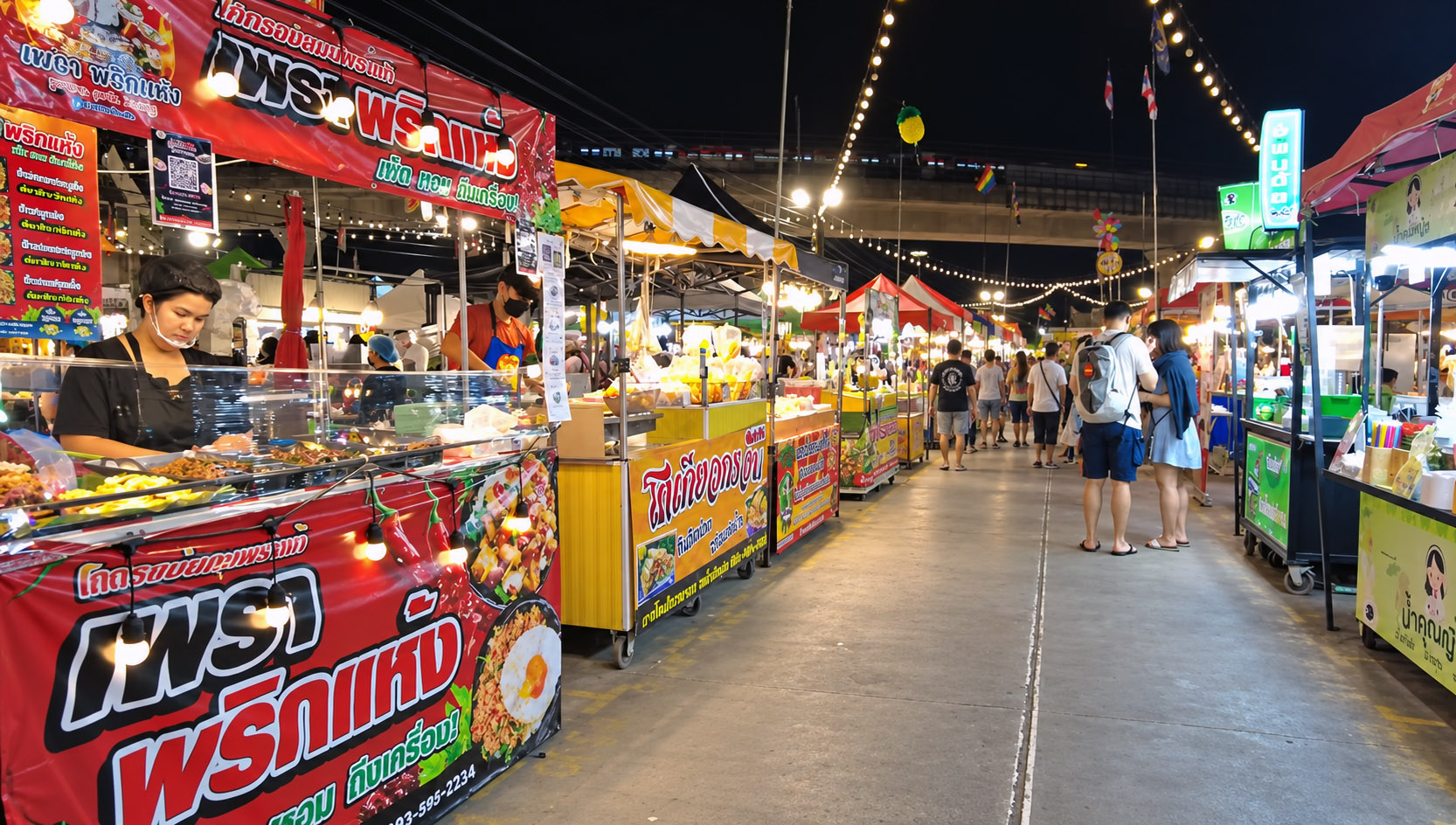
Bangkok is one of those cities where finding food rarely requires much planning. Finding good street food somewhere convenient, however, is a slightly different question. The famous markets are useful, but you do not always want to cross half the city because somebody on YouTube has declared one particular noodle stall life-changing.
A much simpler strategy is to use the BTS Skytrain as your food map. Around many stations, a short walk is enough to reach a traditional market, a collection of food stalls, a commuter lunch street or sometimes one exceptionally popular cart. This guide concentrates on places where there is a genuine reason to get off the train rather than listing every BTS stop followed by the words “you may find food nearby”.
Walking times are approximate and calculated from the most convenient station exit. Markets tend to be reasonably predictable; carts are not. Bangkok street vendors can change position, disappear for a day or alter their schedule without consulting either Google or Lonely Punter, so treat the times below as useful ranges rather than contractual obligations.
If you only want the shortlist, On Nut is probably the easiest instant street-food hit, Victory Monument is the place for boat noodles, Phloen Chit is excellent for a weekday local lunch, Nana is unusually useful from daytime until very late at night, and Talat Phlu is worth the trip for a more local evening market. The full network offers considerably more.
Sukhumvit Line: North Bangkok
The northern extension of the Sukhumvit Line is particularly useful if you want markets that still function mainly for Bangkok residents. The farther you travel from Siam, the less likely you are to encounter food stalls designed around tourists and the more likely you are to find places where dinner is simply dinner.
Yaek Kor Por Aor BTS (N23) – Save One Go Market
Save One Go Market is practically beside Yaek Kor Por Aor station, making it one of the easiest night markets in this entire guide. Use Exit 4 and you should be among the stalls within a couple of minutes. The market normally gets going in the late afternoon and runs until around midnight, combining large quantities of inexpensive street food with clothing, accessories and the normal assortment of things you did not intend to buy when you left the hotel.
The main reason to come is that this still feels overwhelmingly like a neighbourhood market despite being directly connected to the BTS. Food is inexpensive, portions are often small enough to sample several things, and the distance from central Bangkok filters out most casual visitors. It is a long train ride from Sukhumvit, but almost no walk at the other end.
Sai Yud BTS (N19) – Ying Charoen Market
A few stops south, Ying Charoen Market is a different proposition. This is a large traditional market rather than a night market assembled primarily around eating, with meat, seafood, vegetables and other fresh produce alongside cooked dishes, snacks, desserts and takeaway food. It sits only a few minutes from Sai Yud BTS, although the exact walking distance depends on which entrance you use.
Come here if you want to see a proper working Bangkok market rather than an organised street-food attraction. It is large, functional and used throughout the day by people who have actual shopping to accomplish, which has the useful side effect of creating plenty to eat.
Wat Phra Sri Mahathat BTS (N17) – Scout Food Camp 1 Bang Khen
Close to Wat Phra Sri Mahathat station, Scout Food Camp 1 Bang Khen is more deliberately designed as a food-and-evening destination. It is only a couple of minutes on foot from the BTS and normally becomes livelier from the afternoon onward, continuing through the evening and into the night.
Expect numerous food stalls, drinks, seating, occasional live music and a relaxed local crowd rather than the sensory assault of central Bangkok’s largest night markets. It is especially useful if you are staying toward Don Mueang or exploring northern Bangkok and want somewhere that does not require another thirty-minute journey simply to eat.
Ratchayothin BTS (N11) – Green Vintage Night Market
Around three minutes from Ratchayothin station, Green Vintage Night Market combines food with vintage clothing, accessories, collectibles and general night-market browsing. It is not a dedicated food market, but there are enough stalls to make eating a substantial part of the evening rather than emergency refuelling between racks of second-hand shirts.
The market is most useful if you want food and something else to do afterwards. It regularly hosts events and live entertainment, so the atmosphere can vary considerably depending on the evening. Arrive after the heat begins to ease and allow yourself to wander rather than treating it as a targeted dinner reservation.
Ha Yaek Lat Phrao BTS (N9) – Liabduan Danneramit Night Market
Liabduan Danneramit sits roughly seven or eight minutes from Ha Yaek Lat Phrao and has become one of the better large night-market options accessible from the northern BTS line. The market generally operates from late afternoon to around midnight, with street food mixed among shopping, entertainment and a distinctly old-school Thai night-market atmosphere.
There are easier places to eat if convenience is the only concern, but Danneramit makes sense as an evening destination in its own right. Come hungry, sample several vendors and accept that a market containing food, shopping and fairground-style entertainment was never intended for a disciplined forty-minute visit.
Mo Chit BTS (N8) – Chatuchak Weekend Market
Chatuchak Weekend Market hardly qualifies as a hidden discovery, but excluding it from a BTS street-food guide would be unnecessarily contrarian. From Mo Chit, Exit 1 gets you into the market area in roughly five minutes, and once inside there is no shortage of grilled meat, noodles, seafood, fruit, drinks, desserts and snacks.
Food is not the market’s main purpose, and prices are not necessarily the lowest in Bangkok, but the sheer size of Chatuchak means you can eat continuously while accomplishing very little shopping. Saturday and Sunday remain the important days. If you are already coming for the market, there is no reason to schedule lunch somewhere else.
Saphan Khwai BTS (N7) – Pradiphat Road
Pradiphat Road is interesting precisely because there is no formal market to photograph at the entrance. Walk around five minutes from Saphan Khwai in the late afternoon and food carts, small clusters of stalls and inexpensive local restaurants begin appearing along the road and surrounding streets.
The scene is strongest around the end of the working day and is much more spontaneous than a purpose-built night market. Come here if the sight of a row of ordinary Bangkok residents waiting for dinner interests you more than another neon sign announcing that you have arrived at an “authentic market”.
Ari BTS (N5) – Soi Ari and Ari Soi 1
Ari has become known for cafés, restaurants and increasingly fashionable businesses, but street food has not disappeared beneath all the flat whites. From Ari BTS, vendors begin appearing within a couple of minutes and continue along Soi Ari, Soi 1 and surrounding streets, mixed into the ordinary daily life of the neighbourhood.
There is no single destination to aim for and no official opening ceremony each evening. That is exactly the appeal: get off the BTS, walk into the sois and see what is operating. Ari works particularly well around lunch and the early evening, when traditional vendors coexist rather comfortably with Bangkok’s more polished contemporary food scene.
Victory Monument BTS (N3) – Boat Noodle Alley
Victory Monument is one of the most useful food stops on the entire BTS network. Follow the route from the station toward the canal and, within roughly five to eight minutes, you reach the cluster of restaurants famous for guay tiew ruea — boat noodles. The small bowls descend from a style of noodles once served from boats, and the sensible approach is to order several rather than staring suspiciously at the portion size.
The wider area around the monument is worth attention too. Thousands of commuters, students, bus passengers and minivan travellers pass through every day, supporting a constant ecosystem of fast, inexpensive food. Come for the boat noodles, but look around before getting back on the train.
Ratchathewi BTS (N1) – Phetchaburi Soi 5
About six minutes from Ratchathewi BTS, Phetchaburi Soi 5 becomes a genuine neighbourhood food street in the late afternoon. Vendors serve rice dishes, noodles, grilled meat, fried snacks, sweets and drinks as the street becomes busier toward dinner.
This is a good alternative when you want street food relatively close to Siam without eating somewhere built around Siam’s visitor traffic. The atmosphere remains practical and local, and the number of options makes it easy to assemble dinner one stall at a time.
Siam BTS – One Cart Can Be Enough
Siam is the epicentre of air-conditioned Bangkok, surrounded by malls and food courts large enough to qualify as minor municipalities. Yet one of the more interesting food stops can be considerably less sophisticated: around Siam Square Soi 3, near Watsons, a popular fried-chicken cart has long attracted students, workers and anyone prepared to join the queue.
This is exactly the kind of recommendation that requires flexibility. A street cart is not a monument; hours and even position can change, so do not cross Bangkok solely for it. If you are already around Siam Square and it is operating, however, the queue will usually identify it more effectively than signage. Nearby Siam Pandan, known for its small green pandan cakes, provides a more permanent snack option if fried chicken proves elusive.
Central Sukhumvit: Street Food Around the Business and Nightlife Districts
Central Sukhumvit appears dominated by hotels, shopping malls, office towers and nightlife, but street food survives in the gaps between them. The most interesting locations are often shaped by time: one street belongs to office workers at noon and another to bar staff, taxi drivers and late-night customers several hours after midnight.
Phloen Chit BTS (E2) – Ploenchit Market
Almost hidden beneath the elevated infrastructure close to Phloen Chit BTS, Ploenchit Market is one of the best weekday food stops in central Bangkok. Exit 4 puts you only a few minutes away from rows of stalls selling rice and curry, noodles, made-to-order dishes, Isaan food, snacks, fruit and drinks.
This is primarily an office-worker market, so timing matters more than it does at a night market. It operates on weekdays from early morning until early afternoon and becomes particularly busy around lunch; weekends are the wrong time to arrive. The surroundings may lack romance, but food courts under concrete infrastructure are often where Bangkok gets unexpectedly practical.
Nana BTS (E3) – Different Streets, Different Hours
Nana is perhaps the most interesting station in this guide because there is no single street-food market to locate. The vendors move with the rhythm of the neighbourhood, and that rhythm changes dramatically from lunch to midnight. If you are staying around lower Sukhumvit, understanding the timing is more useful than memorising one pin on a map.
During the day, Sukhumvit Soi 8 regularly has small groups of carts and stalls, particularly around lunch. They are not numerous enough to justify a special journey, but they are extremely convenient if you are already nearby and want something faster and cheaper than the area’s restaurants.
After dark, Soi 4 becomes more useful. Street-food carts appear as the nightlife gets busier and some continue operating well into the night, feeding workers, visitors, taxi drivers and people whose dinner plans somehow became breakfast plans. Soi 11 also tends to have scattered vendors at various points along the street, although the exact locations are less predictable.
For the genuinely nocturnal, the area has another layer rarely mentioned in conventional food guides. Around Soi 7/1, Soi 11/1 and nearby late-night streets, small motorised carts sometimes circulate rather than setting up permanently, selling fruit, ice cream, snacks and other food into the early hours. These carts are often more useful to the women working in the surrounding bars than to tourists themselves: staff step outside between customers or after work to buy fruit, drinks or something quick to eat, so the carts follow the rhythm of the nightlife economy rather than the conventional dinner crowd.
These same streets are also among the more interesting parts of lower Sukhumvit for punters out late, especially once the regular restaurants begin closing and the bar scene takes over completely. The food carts are only one small detail of that ecosystem; how the bars operate, what different venues offer and how the more adult side of Soi 7/1, Soi 11/1 and the surrounding area actually works belongs in the dedicated Bangkok After Dark section.
Asok BTS (E4) – SW1 Market
Asok provides the organised counterpart to Nana’s moving collection of carts. SW1 Market, close to Sukhumvit Soi 12 and only a few minutes from the station, gathers food stalls in a recognisable semi-outdoor space rather than scattering them through several sois.
It is not the rawest street-food experience in Bangkok, but that is not always a disadvantage. The central location, easy BTS access and evening atmosphere make it particularly useful when you want a market-style dinner without dedicating half the night to travelling there.
Thong Lo BTS (E6) – The Morning Version of Thonglor
Thonglor is normally associated with expensive restaurants, Japanese food, cocktail bars and Bangkok residents who apparently own better clothes than you. Go early in the morning, however, and the area around Sukhumvit Soi 57 shows a much more ordinary side.
The small local market near the BTS focuses mainly on fresh produce but also includes cooked food and breakfast items for neighbourhood residents. It is not somewhere to visit expecting fifty street-food stalls and live music. Its value lies in seeing Thonglor before the restaurants open and before the neighbourhood puts on its evening clothes.
East Along Sukhumvit
Continuing east from central Bangkok, the Sukhumvit Line becomes increasingly useful for finding residential markets and inexpensive local food. These stops are particularly good if you have already done Chinatown and Chatuchak and want somewhere that does not appear on every first-time Bangkok itinerary.
Phra Khanong BTS (E8) – Phra Khanong Market
Around six to eight minutes from the station, Phra Khanong Market remains a working neighbourhood market built around fresh food, ingredients and prepared dishes. It also reflects the area’s substantial Myanmar community, so the food selection can move beyond standard central-Thai market fare.
This is not a polished destination and that is precisely why it is worth including. Browse the interior market and surrounding streets rather than looking only for one row of food stalls; much of the interesting eating is mixed into a market people actually use for groceries.
On Nut BTS (E9) – The Easiest Street-Food Stop
If this article had to recommend one BTS station purely for convenience, On Nut would probably win. Leave the station on the Lotus’s side near Exit 2 and you are essentially already in the food area, with numerous vendors becoming particularly active from the afternoon into the evening.
Grilled pork skewers, noodles, pad thai, curries, fruit and whole salt-crusted fish are typical finds, and there is usually enough seating nearby to turn random purchases into an actual dinner. Prices tend to be lower than around central Sukhumvit, while the crowd mixes Thai residents with expats living in the area. There is no need to turn this into a research project: get off the BTS, walk toward the food and start ordering.
Bang Chak BTS (E10) – Bang Chak Market
One stop farther east, Bang Chak Market near Sukhumvit Soi 95 offers a smaller and still more residential alternative. Fresh produce shares space with ready-to-eat food, grilled meat, chicken, rice dishes, snacks and fruit, and the market is only a few minutes from the BTS.
Bang Chak is less of an evening destination than On Nut and more of an everyday neighbourhood market. That makes it useful if you want to see where local residents actually shop rather than another location where everyone is holding a phone in front of dinner.
Udom Suk BTS (E12) – Market Food Around Soi 103
At the entrance to Sukhumvit Soi 103, roughly three minutes from Udom Suk BTS, market stalls and food vendors create another strong local eating area. Different parts of the market operate at different times, but the late afternoon and early evening generally provide the most useful combination of prepared food and street vendors.
Udom Suk has changed considerably as development has moved farther east along Sukhumvit, yet the street around the station remains far less polished than central Bangkok. It is another good place to arrive without a specific dish in mind and let whatever is coming off the grill settle the matter.
Pak Nam BTS (E19) – Pak Nam Market
By the time the Sukhumvit Line reaches Pak Nam, you are well beyond the usual Bangkok visitor circuit and into Samut Prakan. Pak Nam Market, about four minutes from the station, is a genuine municipal market serving local residents, with fresh produce, seafood, cooked meals and numerous ready-to-eat snacks.
The point of coming this far is not that the food is magically superior to everything downtown. It is that the environment is different, prices are local and very few visitors ride the BTS this distance simply because they are hungry. If you enjoy markets as much as eating, Pak Nam is worth the journey.
Phraek Sa BTS (E21) – Black Market
Black Market, almost beside Phraek Sa BTS, is another reason to continue farther into Samut Prakan. From late afternoon until around midnight, the compact market combines inexpensive street food, small shopping stalls, drinks and the relaxed evening atmosphere of a neighbourhood night market.
It is far from central Bangkok but extremely easy once you arrive, with almost no last-mile transport required. For travellers who have seen enough carefully curated central night markets, this is one of the more interesting examples of what the BTS extensions have made accessible.
Silom Line
The Silom Line gives you a different cross-section of Bangkok: shopping around MBK, office-worker lunches in Silom, old food districts around Bang Rak and increasingly local markets once the train crosses the Chao Phraya into Thonburi.
National Stadium BTS (W1) – Outside MBK
Most visitors associate MBK with shopping and its indoor food courts, but look outside the building and the experience changes. Along Phaya Thai Road and the surrounding sidewalks, food carts and small groups of vendors appear at different times of day, generally within a few minutes of National Stadium BTS.
The number and exact position vary, so this is not somewhere to arrive clutching a screenshot of one particular stall. It works best as an opportunistic food stop while you are already around MBK, Siam or the Bangkok Art and Culture Centre.
Sala Daeng BTS (S2) – Convent Road
Convent Road is one of the best weekday examples of Bangkok’s office-lunch street food. From roughly late morning through lunchtime, vendors serve workers from the surrounding Silom business district, producing a dense selection of rice dishes, noodles, grilled food, snacks and desserts only a few minutes from Sala Daeng BTS.
Do not come on a quiet Sunday evening and conclude that Lonely Punter has invented the place. Its whole identity comes from weekday office traffic, and lunch is when it makes sense.
Chong Nonsi BTS (S3) – Lalai Sap Market
A short walk from Chong Nonsi, Lalai Sap Market is another market shaped by Bangkok’s working population. It runs primarily on weekdays from the morning into early afternoon, with its strongest food activity around breakfast and lunch when surrounding office workers arrive for noodles, curry over rice, sweets, fruit and takeaway meals.
Food shares the narrow lanes with clothes, accessories and household goods, so Lalai Sap feels less like a culinary attraction and more like an intensely compressed urban market. Go before the afternoon winds down; this is not a night-market substitute.
Saphan Taksin BTS (S6) – Bang Rak and Charoen Krung
Get off at Saphan Taksin, walk toward Charoen Krung and you are entering one of Bangkok’s historically important food districts. Around Ma! Bang Rak and the neighbouring streets, market food, old restaurants and small vendors blend into the everyday commercial life of the district, while the Chao Phraya is only a few minutes away.
About eight minutes from the station, Charoen Saeng Silom is worth knowing even though it is a restaurant rather than a street-food zone. The old shop is famous for its Chinese-style braised pork leg and works best in the morning or at lunch before popular items disappear. Bang Rak is a good reminder that this guide is about useful food within walking distance of the BTS, not about forcing everything into the definition of a night market.
Wongwian Yai BTS (S8) – Somsak Pu-Ob
Roughly five to seven minutes from Wongwian Yai, Somsak Pu-Ob is another single address worth breaking the market rule for. The speciality is goong ob woonsen or pu ob woonsen — glass noodles cooked in a pot with prawns or crab, pepper, herbs and sauce.
The popularity of the place proves that an entire street full of stalls is not required for a worthwhile food stop. Go in the late afternoon or evening, order the noodles and let somebody else worry about constructing a comprehensive tasting itinerary.
Talat Phlu BTS (S10) – First One Night Market
Around six minutes from Talat Phlu BTS, First One Night Market is one of the strongest evening choices on the western side of the river. It normally runs from late afternoon until around midnight, with plenty of food stalls, seating, drinks and a largely local crowd.
The wider Talat Phlu neighbourhood has its own deep food tradition, so the market can serve as the beginning rather than the end of an evening. Eat something, wander the surrounding district and keep enough appetite in reserve to investigate anything with a queue.
Which BTS Stations Are Actually Worth the Trip?
If convenience matters most, start with On Nut: the transition from train to food is almost comically efficient. Victory Monument is the obvious specialist stop for boat noodles, while Phloen Chit and Lalai Sap show the weekday food culture of Bangkok’s office districts. For a proper evening market, Save One Go, Liabduan Danneramit, Black Market and First One all provide different versions of the same basic Bangkok idea: affordable food, shopping and sitting around until there is no defensible reason to order another skewer.
Nana is the odd one out, and perhaps the most Lonely Punter stop in the guide. It does not offer one market but an evolving street-food landscape that follows the neighbourhood’s nightlife: Soi 8 by day, Soi 4 and Soi 11 in the evening, then mobile carts around some of the late-night streets after conventional dinner hours have become irrelevant. The fact that many of those carts primarily serve the women working in the surrounding bars rather than tourists makes the area even more interesting as a glimpse into how lower Sukhumvit functions once the conventional city has gone to bed.
For something less central, Pak Nam, Phraek Sa, Sai Yud and Yaek Kor Por Aor demonstrate how useful the expanded BTS network has become. None needs to be considered an essential Bangkok attraction, but all make excellent food excursions if you have already worked through the famous markets and would rather see how the rest of the city eats.
A Final Note About Opening Times
Bangkok changes too quickly for a street-food guide to pretend otherwise. Established markets usually keep reasonably regular schedules, but individual stalls may arrive late, finish early, move down the road or simply not appear that day. Weather, holidays, redevelopment and local enforcement can all alter what you find on a particular evening.
Use the station, walking time and general time of day as your framework rather than expecting every cart to stand exactly where somebody photographed it six months ago. Once you get off the BTS, pay attention to smoke, queues and where local people are eating. In Bangkok, the most useful recommendation is sometimes fifty metres beyond the one you originally came looking for.


